• About

Desperado's Outpost

Desperado's Outpost

Category Archives: economy

Obama Hearts the “Gang of Six” Plan

20 Wednesday Jul 2011

Posted by Craig in budget, Congress, economy, health care, Medicaid, Medicare, Obama, Politics, Social Security, Taxes, Unemployment

≈ 2 Comments

Tags

Alternative Minimum Tax, CLASS Act, corporate tax cuts, deficit reduction, economic growth, Gang of Six, marginal tax rates, Medicaid, Medicare, Obama, overseas profits, Pentagon, Social Security, spending caps, supply side

President Obama was quick to endorse the latest deficit reduction plan, the one from the so-called “Gang of Six” released yesterday, calling it a “very significant step” and “broadly consistent with the approach he has advocated.” This without knowing the details. But the details weren’t really important, because all the major elements are indeed consistent with what the president wants in this deficit reduction shell game.

* Medicare, Medicaid, and Social Security cuts.
* Further cuts in the top marginal income tax rates. (So much for that pledge to let the Bush tax cuts expire).
* Corporate tax cuts.
* The continuation of Reaganomics and Bushonomics. That would be the supply-side, tax cuts equals increased revenue and economic growth nonsense that we all know works so well.

The broad strokes of the “Gang of Six” plan (and just as an aside I wonder why Sen. Sanders is never included in any of these gangs? Not bi-partisany enough, I assume) are as follows:

An immediate $500 billion “down payment” on deficit reduction. All spending cuts, all from unnamed programs. A brilliant idea in a recession. The other $3.2 trillion in savings would be decided by various committees at some later date, enforced by spending caps. Congress would be required to get a 2/3 vote to exceed those caps. IOW, when the next recession hits, anybody looking for any assistance is SOL. David Dayen at Firedoglake:

“Simply put, this is a recipe for depression. When the economy suffered and stimulus would be required to increase aggregate demand, the 2/3 vote needed would simply put a stop to it. The New Deal would have been out of order under this regime. Same with the Recovery Act. Any spending from the federal government would be restricted as much as it is in the states. So there could only be the status quo or contraction in fiscal policy in the event of a recession, which is a perfect way to create a depression.”

Also in the down payment would be the institution of chained CPI, aka a cut in SS benefits, and repeal of the CLASS Act, which was a part of health care reform that the insurance lobby fought tooth and nail. From the New York Times, December of 2009:

“The Class Act, which the late Sen. Ted Kennedy considered his legacy, would allow people to buy long-term care insurance through payroll deductions and to receive cash if they’re later disabled, regardless of their age or of a previous health condition. “This is the best chance the baby boomers have to protect themselves from impoverishment if they need long-term care,” Mr. [Jim] Firman [president of the National Coalition on Aging] said.”

That is Part One. Part Two calls for an additional $200 billion in “healthcare savings,” aka Medicare and Medicaid cuts, and an $80 billion cut in the defense budget. That’s $80 billion over ten years, pocket change for the Pentagon. Gotta love that shared sacrifice.

In Part Two, the Finance Committee…

“…would be required to reduce tax rates to three tax brackets of rates: of 8-12 percent, 14-22 percent and 23-29 percent. The current top marginal rate is 35 percent. The corporate tax rate would be between 23 percent and 29 percent…”

And this little goodie for corporations as well:

“…tax reform would cease taxation of overseas profits.”

The corporate behemoths had been lobbying to get the tax on overseas profits reduced, allegedly under the guise of returning these profits for use in job creation, but that’s not how it worked before:

“Congress and the Bush administration gave companies a similar tax incentive, in 2005, in hopes of spurring domestic hiring and investment.

While the tax break lured 800 companies into bringing $312 billion back to the United States, 92 percent of that was used for dividends and stock buybacks, according to the nonpartisan National Bureau of Economic Research. The study concluded the program “did not increase domestic investment, employment or research and development.”

Indeed, 60 percent of the benefits went to 15 of the largest U.S. multinational companies — many of which laid off domestic workers, closed plants and shifted even more profits and resources abroad in hopes of cashing in on the next repatriation holiday.”

So let’s just eliminate the tax entirely. Nice.

More on the tax “reform” aspects of this plan:

“Coburn said the plan would reduce the deficit by $3.7 trillion over the next 10 years and increase tax revenues by $1 trillion by closing a variety of special tax breaks and havens. He also noted, however, that the Congressional Budget Office would score the plan as a $1.5 trillion tax cut because it would eliminate the Alternative Minimum Tax.”

I’m not sure how that works. How is $1 trillion in revenue increases scored as a $1.5 trillion tax cut? But I know for sure how this works, it doesn’t:

“It would generate a significant amount of revenue out of tax reform and reduction of tax rates, which authors believe would spur economic growth.”

And I believe in the Tooth Fairy and the Easter Bunny.

9.2% Unemployment is Fiction, 16.2% is Reality

19 Tuesday Jul 2011

Posted by Craig in economy, Politics, Unemployment

≈ 1 Comment

Tags

16.2%, 1800 workers, Economic Populist, Ford, JOLT, Louisville assembly plant, U6, unemployment

Economic Populist has a graph showing why the “official” unemployment rate of 9.2% should be disregarded as a disingenuous statistic intended to make the unemployment picture look better than it actually is, and why the U6 rate of 16.2%—which includes unemployed, underemployed, and those who have given up looking—is a much more accurate indicator:

“JOLTS stands for Job Openings and Labor Turnover Survey. The July 12th report on May 2011 data shows there were 4.68 official unemployed people hunting for a job to every position available.

If one takes the…broader definition of unemployment, or U6, in May at 15.8%, the ratio becomes even worse, 8.28 unemployed people per each job opening for May. Bear in mind U6 jumped to 16.2% in June. Below is the graph of number of unemployed, using the broader U6 unemployment definition, per job opening.


Here’s proof:

“Some 16,837 people showed up at the local Kentucky Office of Employment & Training in the past week seeking jobs at Ford’s Louisville Assembly Plant.

The deadline was today to submit an application and a lottery tomorrow picks who gets to go on for consideration by Ford for the jobs paying $15.51 per hour. The number who’ll advance via the lottery wasn’t disclosed.

Sadly, the odds are that very few of these folks will become one of the 1,800 more workers Ford says it needs to reopens the plant in November…”

16,837 people divided by 1,800 openings comes out to roughly 9.3 applicants per job. A lot closer to 8.28 that 4.68.

Confidence, Schmonfidence

18 Monday Jul 2011

Posted by Craig in economy, Unemployment

≈ 2 Comments

Tags

certainty, confidence, David Cote, FDR, Honeywell, John Kasich, Meet The Press, Obama, outsourcing, press conference, regulation, roundtable, taxes, union busting

Whenever I see a discussion about the real crisis this country faces—that would be unemployment, not the manufactured one over the deficit– a couple of words keep coming up from the alleged smartest guys in the room, confidence and certainty. Businesses would hire, so it’s said, if they had either or both.

President Obama referred to it in a recent press conference:

“What we need to do is to restore business confidence and the confidence of the American people that we’re on track — that we’re not going to get there right away, that this is a tough slog, but that we still are moving forward.”

It came up again yesterday in a roundtable discussion about jobs on Meet the Press. Just as an aside, two members of this roundtable were Ohio Governor John Kasich and Honeywell CEO David Cote. It has been estimated that Kasich’s budget cuts in Ohio could lead to over 50, 000 layoffs. Mr. Cote’s history at Honeywell, where his 2010 compensation topped $20 million, has been one of outsourcing and union-busting. Just the two opinions you want on what to do about unemployment, right?

Mr. Kasich and Mr. Cote, who also sits on the board at JP Morgan Chase, spoke about the need for businesses to have certainty. Certainty about taxes and regulation. Certainty meaning lower taxes and less regulation, naturally.

In August of 1934, President Franklin Roosevelt addressed the same issues we face today. Here’s what FDR had to say about confidence:

“In one year and five months, the people of the United States have received at least a partial answer to their demands for action; and neither the demand nor the action has reached the end of the road.

But, my friends, action may be delayed by two types of individuals. Let me cite examples: First, there is the man whose objectives are wholly right and wholly progressive but who declines to cooperate or even to discuss methods of arriving at the objectives because he insists on his own methods and nobody’s else.

The other type to which I refer is the kind of individual who demands some message to the people of the United States that will restore what he calls “confidence.” When I hear this I cannot help but remember the pleas that were made by government and certain types of so-called “big business” all through the years 1930, 1931 and 1932, that the only thing lacking in the United States was confidence.

Before I left on my trip on the first of July, I received two letters from important men, both of them pleading that I say something to restore confidence. To both of them I wrote identical answers: “What would you like to have me say?” From one of them I have received no reply at all in six weeks. I take it that he is still wondering how to answer. The other man wrote me frankly that in his judgment the way to restore confidence was for me to tell the people of the United States that all supervision by all forms of Government, Federal and State, over all forms of human activity called business should be forthwith abolished.

Now, my friends, in other words, that man was frank enough to imply that he would repeal all laws, State or national, which regulate business—that a utility could henceforth charge any rate, unreasonable or otherwise; that the railroads could go back to rebates and other secret agreements; that the processors of food stuffs could disregard all rules of health and of good faith; that the unregulated wild-cat banking of a century ago could be restored; that fraudulent securities and watered stock could be palmed off on the public; that stock manipulation which caused panics and enriched insiders could go unchecked. In fact, my friends, if we were to listen to him and his type, the old law of the tooth and the claw would reign in our Nation once more.

The people of the United States will not restore that ancient order. There is no lack of confidence on the part of those business men, farmers and workers who clearly read the signs of the times. Sound economic improvement comes from the improved conditions of the whole population and not a small fraction thereof.

Those who would measure confidence in this country in the future must look first to the average citizen.”

Confidence, schmonfidence. Businesses don’t need either confidence or certainty, they need customers. Those would-be customers need jobs. We’ve had 30+ years of low taxes and less regulation. If those were the engines of job creation we’d have more jobs than we do people.

The More Things Change…

17 Sunday Jul 2011

Posted by Craig in economy, Taxes

≈ Leave a comment

Tags

1936, FDR, taxes

…the more they stay the same. FDR, 1936:

“In 1776 the fight was for Democracy in Taxation. In 1936 there is still the fight. Mister Justice Oliver Wendell Holmes once said ‘taxes are the prices we pay for civilized society’. One sure way to determine the social conscience of a government is to examine the way taxes are collected and how they are spent.

And one sure way to determine the social conscience of an individual is to get his tax reaction. Taxes, after all are the dues we pay for the privilege of membership in an organized society. And as society becomes more civilized government, national and state and local, is called on to assume more obligations to its citizens. The privileges of membership in a civilized society are vastly increased in modern times. But I am afraid we still have many who still do not recognize their advantages and want to avoid paying their dues.”

To divide fairly among the people the obligation to pay for these benefits has been a major part of our struggle to maintain Democracy in America. Ever since 1776, that struggle has been between two forces; on the one hand there has been a vast majority of citizens who believe the benefits of democracy should be extended and who are willing to pay their fair share to extend them. And on the other hand, there has been a small but powerful group which has fought the extension of these benefits because they did not want to pay a fair share of their cost.

That was the lineup in seventeen hundred and seventy-six and it’s the lineup today. And I am confident that once more, in nineteen thirty-six democracy in taxation will win. Here is my principle, and I think it’s yours too; Taxes shall be levied according to ability to pay. That is the only American principle.”

Remember Unemployment?

15 Friday Jul 2011

Posted by Craig in budget, economy, Unemployment

≈ Leave a comment

Tags

2009, CEO compensation up 18%, duration of unemployment, employee compensation to GDP ratio, employment to population ratio, given up looking, low income jobs, not in labor force, part-time, state and local cuts, unemployment

I know it’s not high on our elected officials’ priority list right now, if it’s even on the list at all, but it’s still around. A little thing called unemployment. Remember that? A few statistics the actors in the debt ceiling soap opera might want to consider during a break from their bickering:

The official unemployment rate, the one juggled to make things look better than they actually are, is currently 9.2%. But that’s just the tip of the iceberg. Not counted in that number are the 8.6 million who are working part-time when they’d rather have full-time work, and the 4 million who have given up looking. Add those to the mix and the number goes to 16.2%,

“As of May, 6.2 million had been out of work for more than six months and more than 4 million haven’t work in more than a year…Of those who had been unemployed for more than six months, slightly more than 10% found new jobs. Nearly 19% dropped out of the workforce.”

Almost twice as likely to drop out of the work force than find a job. How sad is that?

The average duration of unemployment is 40 weeks (click to enlarge):

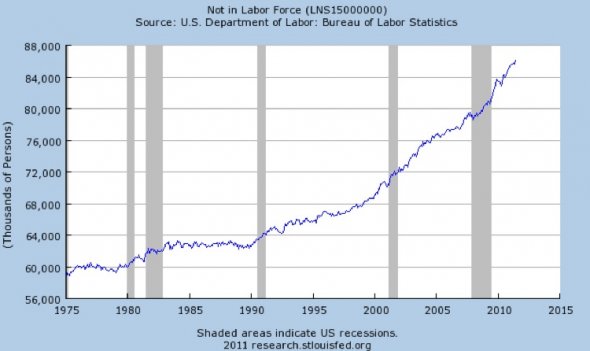
The number of people not in the labor force is at an all-time high:


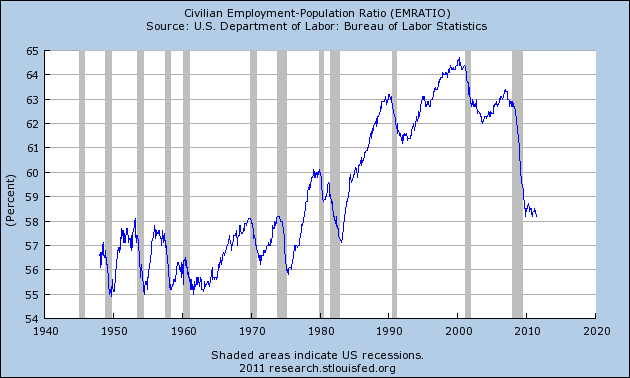
The employment to population ratio is at its lowest point since the early 1980’s:


If that wasn’t bad enough, state and local governments may cut nearly 500,000 more jobs by the end of this year.

For those fortunate enough to find a job, that job is likely to pay less than what they had.

“Middle income jobs have been replaced by low-income jobs, which now make up 41% of total employment.”

Employee compensation relative to GDP is at its lowest point in over 50 years:


Meanwhile:

“U.S. workers averaged $46,742 in 2010, up 2.6% from 2009. A June GovernanceMetrics analysis found average compensation among S&P 500 CEOs rose to $12 million in 2010, up 18% from 2009 — and that’s not counting the potential multimillion-dollar value of stock or stock options, which are granted at set prices and provide holders profits as stock values rise.”

We now return you to the regularly scheduled debt ceiling theatrics, joined in progress.

Moody’s Threatens Credit Rating Downgrade

14 Thursday Jul 2011

Posted by Craig in budget, economy, Wall Street

≈ Leave a comment

Tags

AAA rating, CDO, MBS, Moody's, Wall Street

Wasn’t it Moody’s who was handing out AAA ratings like candy on Halloween for Wall Street’s toxic MBS, CDO crap not too long ago?

“The “rising possibility” that the debt limit will not be raised by Aug. 2 has driven Moody’s Investors Service to put the nation’s triple-A credit rating on review for a downgrade.

In a statement, the credit-rating agency warned that the risk of a default on U.S. obligations, while low, had risen. A default would “fundamentally alter Moody’s assessment of the timeliness of future payments, and a AAA rating would likely no longer be appropriate,” Moody’s stated shortly after markets closed Wednesday.

The agency also warned that even if the debt limit was raised in time, the nation’s credit rating would retain a negative outlook if no “substantial and credible agreement” also was struck to reduce the deficit “beginning within the next few years.”

Forgive me if I question your credibility.

Unemployment Numbers Don’t Matter? Wanna Bet?

12 Tuesday Jul 2011

Posted by Craig in economy, Obama, Politics, Unemployment

≈ 1 Comment

Tags

economy, Florida, Obama, Romney, Sunshine State News Poll, unemployment

What was that again, Mr. Plouffe? People won’t vote based on the unemployment rate?

“A slipping economy has Floridians moving away from President Barack Obama and warming up to Republican Mitt Romney, a Sunshine State News Poll shows.

The survey of 1,000 likely voters shows that 54 percent disapprove of the job Obama is doing while just 38 percent approve. That result tracks with Florida voters’ sour view of the economy, with 56 percent saying it has worsened in the past year.

“Clearly, the bleak economic landscape is not good news for Obama. This is quite sobering when you consider that the recession technically ended in summer of 2009, which really shows that people don’t believe we are out of the woods by any stretch,” said Jim Lee, president of Harrisburg, Pa.-based Voter Survey Service, which conducted the poll for Sunshine State News.

Today’s numbers may be even worse for Obama, considering that the July 5-7 survey concluded a day before the latest jobless figures were released last Friday. The national unemployment rate rose again to 9.2 percent as the economy added just 18,000 jobs in June.

“Obama’s negative job approval shows there is a major opening for the GOP to win the state in 2012, particularly when you consider that Obama only won by a close 51-48 margin last time,” Lee said. “No president since FDR has won re-election when the unemployment rate on Election Day topped 7.2 percent.”

Economists calculate that the economy would have to add a whopping 250,000 jobs every month for the next year to drive the unemployment rate below 7.5 percent.”

You might want to re-think that re-election strategery, Fluffy.

Why Is This So Damn Difficult?

09 Saturday Jul 2011

Posted by Craig in Afghanistan, budget, economy, Iraq, Medicare, Obama, Politics, Social Security, Taxes, Unemployment, Wall Street

≈ Leave a comment

Tags

$2.2 trillion, Afghanistan, American Society of Civil Engineers, Austan Goolsbee, Bush tax cuts, businesses, certainty, customers, debt, deficit, demand, financial transaction tax, free trade agreements, infrastructure, Iraq, jobs, Medicare, patent process, President Obama, Social Security, Wall Street

This is so simple it’s ridiculous. The three major causes of the dramatic increases in debt and deficit are:

1) The Bush, now Obama, tax cuts.

2) The wars in Iraq and Afghanistan.

3) The financial collapse caused by Wall Street greed.

Ending the tax cuts just for those making over $250,000 will bring in $700 billion over 10 years. The wars cost about $140 billion a year. End both and we save $1.4 trillion over the same 10-year period. A financial transaction tax of just one quarter of one percent will result in $150 billion a year, $1.5 trillion over 10. There’s $3.6 trillion over 10 years, which is just about the same amount the debt ceiling dealers are talking about cutting spending. And we haven’t touched Social Security, Medicare, Medicaid, education, etc. Yet none of these three are even on the debt ceiling/spending cut/revenue increases negotiating table. Why?

The American Society of Civil Engineers estimates the cost of repairing our crumbling infrastructure to be $2.2 trillion over 5 years. Do you see where I’m going here? Take the money we’ve saved, not from cutting the safety net out from under our most vulnerable who had nothing to do with the debt explosion and who did not benefit from it, but from the root causes and from those who did.

The result is millions of Americans have jobs. They’re paying income taxes, Social Security taxes, Medicare taxes. They no longer need unemployment, food stamps, or other forms of government assistance. They’re buying stuff, which creates demand for stuff, which creates more jobs, which creates more demand for stuff. And so on, and so on, and so on. Why is this so damn difficult?

But what do we get from our “leaders?” Gobbledegook and gibberish. Like President Obama’s remarks yesterday after the release of the horrible job numbers. Things like streamlining the patent process, advancing more so-called free trade agreements (which costs jobs rather that create them) and this:

“[T]o put our economy on a stronger and sounder footing for the future, we’ve got to rein in our deficits and get the government to live within its means, while still making the investments that help put people to work right now and make us more competitive in the future.

The sooner we get this done, the sooner that the markets know that the debt limit ceiling will have been raised and that we have a serious plan to deal with our debt and deficit, the sooner that we give our businesses the certainty that they will need in order to make additional investments to grow and hire and will provide more confidence to the rest of the world as well..”

Beside the fact that this is straight of the Republican playbook for economic growth, it’s nonsense (but I’m being redundant). Live within our means while making investments? What the hell is that? Give businesses the certainty they need? Businesses don’t need certainty, they need customers. Customers create jobs, not the ever-elusive confidence unicorn. Why is this so damn difficult?

The president’s mouthpiece at the Council of Economic Advisers, Austan Goolsbe offered more of the same:

“Today’s report underscores the need for bipartisan action to help the private sector and the economy grow – such as measures to extend the payroll tax cut, pass the pending free trade agreements, and create an infrastructure bank to help put Americans back to work.  It also underscores the need for a balanced approach to deficit reduction that instills confidence and allows us to live within our means without shortchanging future growth.”

*Sigh* Can’t anybody here play this game?

The Deficit Reduction Dog and Pony Show, Cont’d

05 Tuesday Jul 2011

Posted by Craig in Deficit, economy, Obama, Politics, Taxes

≈ Leave a comment

Tags

Bush tax cuts, corporate jets, deficit, dog and pony show, hedge fund managers, president, press conference

Further proof that the deficit reduction talk in DC is just a dog and pony show:

“In a Wednesday news conference, the president especially pounded a depreciation provision for corporate jets, mentioning it six times.

“I think it’s only fair to ask an oil company or a corporate jet owner that has done so well to give up that tax break that no other business enjoys,” Obama said. “I don’t think that’s real radical. I think the majority of Americans agree with that.”

But as it turns out, ending the jet tax break would only save around $3 billion over a decade, while rolling back tax expenditures for oil-and-gas would bring in roughly $21 billion and a proposal aimed at hedge fund managers would collect some $15 billion over that same time span.

According to estimates from last year, ending the Bush tax cuts for income over $250,000 for couples would have brought an extra $700 billion into the Treasury.”

If they were serous about reducing the deficit they would, as Willie Sutton once said, go where the money is. But where the money is is also where the large campaign contributions is, so that ends that.

It’s the Demand, Stupid

04 Monday Jul 2011

Posted by Craig in Clinton, economy, Financial Crisis, too big to fail

≈ Leave a comment

Tags

Aspen Ideas Festival, Bill Clinton, Brooksley Born, Commodity Futures Modernization Act, consumer demand, corporate profits, corporate tax rates, derivatives, Glass-Steagall, Paul Krugman

Bill Clinton blathers:

“President Bill Clinton says the nation’s corporate tax rate is “uncompetitive,” and called for a lower rate as part of a “mega-deal” to raise the debt ceiling.

“When I was president, we raised the corporate income-tax rates on corporations that made over $10 million [a year],” the former president told the Aspen Ideas Festival on Saturday evening.

“It made sense when I did it. It doesn’t make sense anymore – we’ve got an uncompetitive rate. We tax at 35 percent of income, although we only take about 23 percent. So, we SHOULD cut the rate to 25 percent, or whatever’s competitive, and eliminate a lot of the deductions so that we still get a FAIR amount, and there’s not so much variance in what the corporations pay.”

Paul Krugman responds:

“Over the last two years profits have soared while employment has remained disastrously high. Why should anyone believe that handing even more money to corporations, no strings attached, would lead to faster job creation?

[…]

[T]he evidence strongly says that the real reason businesses are sitting on cash is lack of consumer demand. In any case, if corporations already have plenty of cash they’re not using, why would giving them a tax break that adds to this pile of cash do anything to accelerate recovery?

[…]

Lack of corporate cash is not the problem facing America. Big business already has the money it needs to expand; what it lacks is a reason to expand with consumers still on the ropes and the government slashing spending.

What our economy needs is direct job creation by the government and mortgage-debt relief for stressed consumers. What it very much does not need is a transfer of billions of dollars to corporations that have no intention of hiring anyone except more lobbyists.”

BTW Bill, I don’t think we need economic advice from the president who set “too big to fail” in motion with the repeal of Glass–Steagall, or the president who lit the fuse on the derivatives time-bomb with the Commodity Futures Modernization Act, or the president who fired Brooksley Born when she tried to warn us about what would happen if derivatives weren’t regulated. Keep it to yourself. Please.

← Older posts
Newer posts →

Recent Posts

  • Turn Out the Lights, the Revolution’s Over
  • Climbing Aboard the Hillary Train
  • You Say You Want a Revolution…
  • Proud to be a War Criminal
  • Drug Testing Welfare Applicants Struck Down in Florida

Archives

  • March 2016
  • February 2016
  • January 2016
  • April 2014
  • January 2014
  • April 2012
  • March 2012
  • February 2012
  • August 2011
  • July 2011
  • June 2011
  • January 2011
  • December 2010
  • November 2010
  • October 2010
  • September 2010
  • July 2010
  • June 2010
  • May 2010
  • April 2010
  • March 2010
  • February 2010
  • January 2010
  • December 2009
  • July 2009
  • June 2009
  • May 2009
  • April 2009
  • March 2009
  • January 2009
  • December 2008
  • November 2008
  • October 2008
  • September 2008
  • August 2008

Blogroll

  • Bankster USA
  • Down With Tyranny
  • Firedoglake
  • Memeorandum
  • naked capitalism
  • Newshoggers
  • Obsidian Wings
  • Taylor Marsh
  • The Market Ticker
  • Tom Dispatch
  • Zero Hedge

Categories

Enter your email address to subscribe to this blog and receive notifications of new posts by email.

Join 7 other subscribers
  • RSS - Posts
  • RSS - Comments

Blog at WordPress.com.

Privacy & Cookies: This site uses cookies. By continuing to use this website, you agree to their use.
To find out more, including how to control cookies, see here: Cookie Policy
  • Subscribe Subscribed
    • Desperado's Outpost
    • Already have a WordPress.com account? Log in now.
    • Desperado's Outpost
    • Subscribe Subscribed
    • Sign up
    • Log in
    • Report this content
    • View site in Reader
    • Manage subscriptions
    • Collapse this bar
 

Loading Comments...