• About

Desperado's Outpost

Desperado's Outpost

Category Archives: too big to fail

Oligarchs of a Feather Stick Together

02 Sunday May 2010

Posted by Craig in economy, financial reform, financial regulation, Goldman Sachs, Politics, too big to fail, Wall Street

≈ Leave a comment

Tags

Goldman Sachs, Lloyd Blankfein, Warren Buffett

Buffett defends Blankfein:

OMAHA, Neb.— Warren Buffett offered a vigorous defense of Goldman Sachs Group Inc. Saturday, saying the embattled firm hadn’t engaged in improper activity and shouldn’t be blamed for the losses of its clients.

[…]

Mr. Buffett’s comments—which came early in the day at Berkshire Hathaway Inc.’s annual shareholders meeting—offer a powerful vote of confidence in Goldman, which has seen its shares slide since the SEC announced the investigation on April 16. Goldman’s stock fell 9.4% on Friday alone after it emerged that the Manhattan district attorney’s office was conducting a preliminary criminal probe into its mortgage-trading activities.

[…]

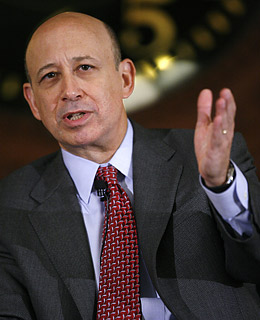
The billionaire investor said he fully supported Goldman CEO Lloyd Blankfein. Asked if he could choose a successor for Mr. Blankfein, Mr. Buffett said: “If Lloyd had a twin brother I’d go for him.”

But he does, Mr. Buffett, he does.

“Put Up or Shut Up” Time on Too Big To Fail

01 Saturday May 2010

Posted by Craig in bailout, Congress, economy, financial reform, financial regulation, Goldman Sachs, Politics, too big to fail, Wall Street

≈ Leave a comment

Tags

amendment, filibuster, financial reform, Huffington Post, Richard Eskow, Senate Republicans, Sherrod Brown, Ted Kaufman, too big to fail

Now that the Senate Republicans have abandoned their filibuster (after perusing the public opinion polls on Wall Street and observing the tap-dancing by Goldman Sachs execs at the Senate Subcommittee on Investigations hearings, I assume) financial reform legislation is set for debate.

Richard Eskow at the Huffington Post has a one-question test we can apply to our elected representatives to tell if they are serious about reforming the financial system or just being a posturing, pontificating blowhard—something that comes naturally to most politicians.

“This quick, easy-to-use test can be applied from the comfort of your own home (if you still have one), from that third job you’ve got to work every evening (too bad you can’t help the kids with homework anymore) … why you can even use it while you’re waiting on line to collect the last of your unemployment benefits!

As long as there’s a television droning away in the waiting area while you wait for that job interview, or a newspaper somebody left behind on that park bench, as long as you can learn how your politician voted, you can learn whether he’s really on your side or just another bank lackey.

Here’s the test: Will they vote to break up the big banks or not? It’s as simple as that … really.

…Yesterday Sens. Ted Kaufman and Sherrod Brown officially introduced an amendment that limits the size of banks and the amount of risk they can take. Under this amendment, no bank could become either so big or so leveraged that its collapse could threaten the economy… An identical amendment was introduced in the House by Reps Brad Miller, Keith Ellison, Steve Cohen, and Ben Chandler.

…What’s striking about the proposal is how simple and effective it is. No bank could hold more than 10% of the nation’s deposits, nor could it leverage (take risks with) sums that amount to more than 2% of the GDP.

What’s also striking is how few institutions it would affect. Only the three biggest banks would be affected by the size limit, and the cap on liabilities would only affect an estimate nine institutions or so.

These amendments offer our representatives in the House and Senate a simple choice: Support a safer and more rational banking system, or be counted among those whose votes are being swayed by the influence of Wall Street money. And they give the rest of us an invaluable tool. We’ll be able to see whether our leaders really means those words about “too big to fail” and “no more bailouts” by seeing whether or not they vote for these amendments.

If they do, they’ve passed the test. If they don’t, they’ve failed. Simple as that.

Here’s the greatest benefit this new test offers to frustrated voters everywhere. It lets us say to politicians, once and for all, on one of the most crucial issues of our day, those words every citizen longs to say to a long-winded public servant:

Put up or shut up.”

Incompetence and Regulatory Capture at Washington Mutual

29 Thursday Apr 2010

Posted by Craig in bailout, Congress, Financial Crisis, financial reform, Politics, too big to fail, Wall Street

≈ Leave a comment

Tags

David Heath, financial reform, Huffington Post, regulatory capture, Washington Mutual

Any questions about why financial reform legislation must have strict provisions for enforcement not left up to the discretion of the so-called “regulators” should be cleared up by David Heath’s extensive piece at the Huffington Post about incompetence, corruption, and regulatory capture at Washington Mutual:

“A recent Senate inquiry offered a rare peek into the secret world of bank examiners. What it revealed was that regulators had stopped regulating.

In the case of Washington Mutual, regulators found all sorts of trouble, from lax lending standards to high delinquency rates on loans, and yet failed to prevent the biggest bank failure in history.

Starting in 2003, examiners for the Office of Thrift Supervision found 545 problems at the bank. But the agency left it up to WaMu to track its own compliance with examiners’ recommendations, and took no formal action against the bank until it was too late.

[…]

A central lesson from the failure of Washington Mutual was that a system set up to prevent what happened utterly failed. For all the talk of reform, Congress isn’t addressing the problem of regulators who fail to do their job.

Regulators routinely deferred to bankers and market forces and engaged in petty squabbles over who had authority over the bank. So the question now is: Can Congress fix ineffective regulators themselves?

[…]

OTS’s own fortunes were heavily tied to Washington Mutual’s. The bank paid fees that amounted to 15 percent of OTS’s budget – more than any other financial institution under its watch. So it was in the OTS’s interest to make sure WaMu survived as a thrift, a bank that specializes in home mortgages.”

Can Congress fix it? Yes they can. Will they? Ay, there’s the rub.

TARP Inspector General Could Have Geithner In His Sights

29 Thursday Apr 2010

Posted by Craig in AIG, bailout, economy, Financial Crisis, Goldman Sachs, Politics, too big to fail, Wall Street

≈ Leave a comment

Tags

Abacus 2007, AIG, Bloomberg, Goldman Sachs, Neil Barofsky, New York Fed, SIGTARP, Timothy Geithner

Timmy might have bigger problems than his inability to use Turbo Tax. Neil Barofsky, Special Inspector General for the Troubled Asset Relief Program, or SIGTARP, is looking into filing charges in the New York Fed’s handling of the AIG–Goldman Sachs monkey business. From Bloomberg:

“The TARP watchdog has…criticized Treasury Secretary Timothy F. Geithner in reports and in congressional testimony for his handling of the process by which insurance giant American International Group Inc. was saved from insolvency in 2008, when Geithner was head of the Federal Reserve Bank of New York.

The secrecy that enveloped the deal was unwarranted, Barofsky says, adding that his probe of an alleged New York Fed coverup in the AIG case could result in criminal or civil charges.

In Senate Finance Committee testimony on April 20, Barofsky said SIGTARP would investigate seven AIG-linked mortgage-related securities similar to Abacus 2007-AC1, the instrument underwritten by Goldman Sachs Group Inc. that is at the center of a U.S. Securities and Exchange Commission lawsuit filed against the investment bank on April 16. “

All I want for Christmas (or Memorial Day, or the 4th of July, or Labor Day, or…) is a REAL Treasury Secretary, not a Wall Street lackey who is susceptible to whiplash every time Jamie Dimon or Lloyd Blankfein make a sudden move. Barofsky, make my wish come true.

Houston, We Have Bi-Partisanship…

29 Thursday Apr 2010

Posted by Craig in bailout, Congress, economy, financial reform, financial regulation, Politics, too big to fail, Wall Street

≈ Leave a comment

Tags

Alan Grayson, audit, Bernie Sanders, Federal Reserve, GAO, Ron Paul, TARP

…at least on the need to audit the Fed:

“As unusual a coalition as can be crafted in the Senate plans to fight for an amendment to the Wall Street reform bill that would open the Federal Reserve to a serious audit by the Government Accountability Office. Sponsored by Sen. Bernie Sanders (I-Vt.), the language is modeled after an amendment that passed the House, sponsored by Reps. Alan Grayson (D-Fla.) and Ron Paul (R-Texas).

Sanders is joined by four Republicans of varying politics: John McCain (Ariz.), Jim DeMint (S.C.), David Vitter (La.) and Sam Brownback (Kan.). If Democrats in the Senate back the measure, it would have at least 63 votes…The chairman of the Judiciary Committee, Sen. Pat Leahy (D-Vt.), is also a cosponsor, as is Sen. Russ Feingold (D-Wisc.).”

A letter by Sen. Sanders reads, in part:

“The American people have a right to know who received over $2 Trillion in financial assistance from the Federal Reserve.

Since the beginning of the financial crisis, the Federal Reserve has provided over $2 trillion in taxpayer-backed loans and other financial assistance to some of the largest financial institutions and corporations in the world. Unfortunately, the Fed is still refusing to tell the American people or the Congress who received most of this assistance, how much they received or what they are doing with this money. This money does not belong to the Federal Reserve, it belongs to the American people, and the American people have a right to know where their taxpayer dollars are going.

[…]

While the Senate financial reform bill attempts to address the lack of transparency at the Fed, as currently drafted, much of the information regarding the details of who received this financial assistance could be kept secret forever.

As long as the Federal Reserve is allowed to keep the information on their loans secret, we may never know the true financial condition of the banking system. The lack of transparency at the Fed could lead to an even bigger crisis in the future.

[…]

For nearly nine decades, the GAO has a proven track record of conducting objective, fact-based, nonpartisan, non-ideological, fair, and balanced audits. Through these audits, the GAO helped save the American taxpayers $50 billion last year alone by rooting out waste, fraud, and abuse in the federal government.

Let’s not equate independence with secrecy. We cannot let the Fed operate in secrecy any longer. There is simply too much money at stake.”

Hear, hear.

A Crucial Week for Financial Reform

26 Monday Apr 2010

Posted by Craig in bailout, Congress, economy, Financial Crisis, financial reform, financial regulation, Obama, Politics, Republicans, too big to fail, Wall Street

≈ Leave a comment

Tags

Blanche Lincoln, Bob Corker, Chris Dodd, claw back, derivative legislation, financial reform, Goldman Sachs, great vampire squid, Harry Reid, letter, Mitch McConnell, Olympia Snowe, President Obama, Richard Shelby, Scott Brown, This Week

In what’s shaping up as a crucial week in the quest for financial reform there are some encouraging signs, some not so encouraging, and a demonstration by the executives at “the great vampire squid” (aka Goldman Sachs) give us an example of why meaningful reform is necessary.

First, the reasons to be hopeful. There appear to be some cracks in the Republican wall of solidarity. Sen. Olympia Snowe endorsed Sen. Blanche Lincoln’s tough stance toward derivative trading passed last week by the Agriculture Committee. (Sen. Grassley, another possible defector, was the lone Republican on the committee who voted for Lincoln’s proposal). In a letter to Majority Leader Harry Reid, Snowe wrote:

“I believe that strong derivatives regulation goes to the heart of an effective financial reform bill and that Chairman Lincoln’s legislation is a strong step towards realizing this fundamental component to financial reform……I believe that we should err on the side of caution and finally bring full transparency to these markets once and for all and allow regulators to preemptively identify these damaged firms.

“Accordingly, I believe the Senate should start with a comprehensive, strong derivatives reform proposal and defend attempts to weaken it, not the other way around and the legislation produced by the Senate Agriculture Committee includes the strongest safeguards and most robust transparency provisions on our expansive derivatives market.

I urge the Majority Leader to incorporate these provisions into the regulatory reform bill.”

On Friday, Sen. Chris Dodd, chairman of the Senate Banking Committee, “agreed to replace his proposed restrictions on derivatives with those of the Senate Agriculture Committee, chaired by Arkansas Democrat Blanche Lincoln.”

On This Week yesterday, Sen. Bob Corker said he intended to propose an amendment containing a “claw back” provision to the legislation “which would take away the personal earnings for the past five years of the corporate officers of failed institutions that fall under the government’s resolution authority.”

Another possible Republican defector might be the newly-elected senator from Massachusetts, Scott Brown. Will someone who was elected as a sort of “man of the people” want to be painted as a defender of Wall Street? Especially when he faces re-election in 2 years? Maybe not.

Also on the positive side, “President Obama and House Financial Services Chairman Barney Frank have personally urged Dodd not to cut a deal with Republicans…This is a welcome sign that Obama realizes that public opinion is moving in the direction of tougher banking reform, and that he learned from the health debate that bipartisan compromise on key reform issues is a snare and a delusion.”

Sen. Dodd has shown signs of weakening the legislation in order to compromise with Republicans leaders in the Senate, Mitch McConnell and Richard Shelby, who want to use the same tactics Republicans used on health care reform—stall and delay as long as possible. Hopefully, Dodd will be emboldened by support from President Obama and not dilute reform to try and pacify those whose intentions are to maintain the status quo.

Now to the crooks at Goldman. What were they doing as the housing market was collapsing and threatening to take the entire economy with it? Having a party:

“As the U.S. housing market began its epic fall nearly three years ago, top executives at Wall Street powerhouse Goldman Sachs cheered the large financial gains the firm stood to make on certain bets it had placed, according to newly released documents.

The documents show that the firm’s executives were celebrating earlier investments calculated to benefit if housing prices fell, a Senate investigative committee found. In an e-mail sent in the fall of 2007, for example, Goldman executive Donald Mullen predicted a windfall because credit-rating companies had downgraded mortgage-related investments, which caused losses for investors.

“Sounds like we will make some serious money,” Mullen wrote.”

To somewhat defend Goldman, what they were doing, “selling short,” (betting against certain investments) is something that happens on Wall Street every day. But, betting against instruments that they designed to fail, and which were sold to investors as AAA investments allowing Goldman to profit from on both ends, may not be illegal (although it should be) but it certainly shows that the execs at the “great vampire squid” have no interest in what’s best for the country. They have one party’s interests in mind—-their own.

William Black on Lehman Fraud

22 Thursday Apr 2010

Posted by Craig in economy, Financial Crisis, financial reform, financial regulation, too big to fail, Wall Street

≈ Leave a comment

Tags

fraud, House Financial Services Committee, Lehman Brothers, William Black

William Black, testifying before the House Financial Services Committee, on the fraud at Lehman Brothers. From Jesse’s Café Americain via Firedoglake:

Simon Johnson and James Kwak on Bill Moyers Journal

22 Thursday Apr 2010

Posted by Craig in bailout, Financial Crisis, financial reform, financial regulation, Politics, too big to fail, Wall Street

≈ Leave a comment

Tags

13 Bankers, Baseline Scenario, Bill Moyers Journal, Financial Crisis, James Kwak, Simon Johnson

Simon Johnson and James Kwak, co-authors of 13 Bankers and co-founders of Baseline Scenario discuss the financial crisis and the need to reform the system. From Crooks and Liars: Vodpod videos no longer available.

more about “Simon Johnson and James Kwak on Bill …“, posted with vodpod

The Most Dangerous Man in the World

20 Tuesday Apr 2010

Posted by Craig in bailout, economy, financial reform, financial regulation, Obama, Politics, too big to fail, Wall Street

≈ Leave a comment

Tags

Baseline Scenario, blackmail, German newspaper, interview, Jamie Dimon, JPMorgan Chase, Simon Johnson, The Most Dangerous Man in America, White House visitor log

In an April 3 post at Baseline Scenario, Simon Johnson called JPMorgan Chase CEO Jamie Dimon “The Most Dangerous Man in America.” Johnson wrote:

“There are two kinds of bankers to fear.  The first is incompetent and runs a big bank.  This includes such people as Chuck Prince (formerly of Citigroup) and Ken Lewis (Bank of America).  These people run their banks onto the rocks – and end up costing the taxpayer a great deal of money.  But, on the other hand, you can see them coming and, if we ever get the politics of bank regulation straightened out again, work hard to contain the problems they present.

The second type of banker is much more dangerous.  This person understands how to control risk within a massive organization, manage political relationships across the political spectrum, and generate the right kind of public relations.  When all is said and done, this banker runs a big bank and – here’s the danger – makes it even bigger.

Jamie Dimon is by far the most dangerous American banker of this or any other recent generation.”

Following an interview with German newspaper Welt am Sonntag on Sunday, that should be amended to read “the most dangerous man in the world” as Dimon issued this not-so-veiled threat on the possibility of stricter bank regulations:

“When profits fall too sharply then capital will move somewhere else, where there is more money to be earned, for example non-regulated markets. The question is, is that what regulators want?”

Blackmail, anyone?

“[Dimon] also said the banking industry could do with more influence on politicians.”

More influence? According to the White House log, since October 30, 2009 Mr. Dimon has made 8, count ‘em 8, visits. What do you want to do, Jamie? Move in?

Are Goldman Charges the Tip of the Iceberg?

19 Monday Apr 2010

Posted by Craig in bailout, economy, Financial Crisis, financial reform, financial regulation, Goldman Sachs, Politics, too big to fail, Wall Street

≈ Leave a comment

Tags

Countrywide, Dylan Ratigan, fraud, German government, Goldman Sachs, Gordon Brown, Lloyd Blankfein, Robert Khuzami, Securities and Exchange Commission

Could Friday’s news that the Securities and Exchange Commission is bringing civil charges of fraud against Goldman Sachs be the tip of the iceberg? Consider what has happened since then.

The German government is considering legal action against Goldman.

British Prime Minister Gordon Brown called for investigations into the bank’s role in the mortgage market.

“The SEC is investigating whether other mortgage deals arranged by some of Wall Street’s biggest firms may have crossed the line into misleading investors.

S.E.C. Enforcement Director Robert Khuzami told CNBC, “We have brought and will continue to pursue cases involving the products and practices related to the financial crisis.” … a wide range of cases are currently being investigated.”

Subprime mortgage king Countrywide is also in the crosshairs:

“Federal criminal investigators looking into the collapse of Countrywide Financial Corp. have been calling witnesses before a grand jury, say people familiar with the matter.”

Former Goldman employees are starting to talk, implicating company execs up to and including CEO Lloyd Blankfein in Goldman’s profiting from the housing market collapse.

Dylan Ratigan has a basic explanation of what Goldman and others were doing. The analogy goes like this—they were selling cars with faulty brakes and then taking out life insurance policies on the people to whom those cars were sold.

But it was even more sinister than that. Goldman not only sold the car with faulty brakes, while telling the buyers that the brakes were good, they designed the car to have faulty brakes, knowing that it was going to crash at some point. So they profited on both ends, selling the car they knew would crash and then collecting the life insurance when it crashed.

Those who are quick to dismiss the charges against Goldman as a tempest in a teapot, something that will quickly blow over after the firm pays a small (relative to their size) fine and goes on their merry way should remember this. It was a night watchman who found a piece of tape on a lock on a door at the Watergate Hotel which led to an investigation which culminated in the resignation of a president.

The question now is do we have a modern-day Woodward and Bernstein? Do we have a modern-day Ben Bradlee who will defy the powers that be and publish the information those reporters uncover in spite of the possible repercussions that those powers may bring to bear? Do we have a modern-day Sam Ervin in Congress? Is there a modern-day John Dean? An ethical person with inside knowledge of the activities at Goldman and other Wall Street giants who is willing to talk?

Time will tell.

← Older posts
Newer posts →

Recent Posts

  • Turn Out the Lights, the Revolution’s Over
  • Climbing Aboard the Hillary Train
  • You Say You Want a Revolution…
  • Proud to be a War Criminal
  • Drug Testing Welfare Applicants Struck Down in Florida

Archives

  • March 2016
  • February 2016
  • January 2016
  • April 2014
  • January 2014
  • April 2012
  • March 2012
  • February 2012
  • August 2011
  • July 2011
  • June 2011
  • January 2011
  • December 2010
  • November 2010
  • October 2010
  • September 2010
  • July 2010
  • June 2010
  • May 2010
  • April 2010
  • March 2010
  • February 2010
  • January 2010
  • December 2009
  • July 2009
  • June 2009
  • May 2009
  • April 2009
  • March 2009
  • January 2009
  • December 2008
  • November 2008
  • October 2008
  • September 2008
  • August 2008

Blogroll

  • Bankster USA
  • Down With Tyranny
  • Firedoglake
  • Memeorandum
  • naked capitalism
  • Newshoggers
  • Obsidian Wings
  • Taylor Marsh
  • The Market Ticker
  • Tom Dispatch
  • Zero Hedge

Categories

Enter your email address to subscribe to this blog and receive notifications of new posts by email.

Join 7 other subscribers
  • RSS - Posts
  • RSS - Comments

Create a free website or blog at WordPress.com.

Privacy & Cookies: This site uses cookies. By continuing to use this website, you agree to their use.
To find out more, including how to control cookies, see here: Cookie Policy
  • Subscribe Subscribed
    • Desperado's Outpost
    • Already have a WordPress.com account? Log in now.
    • Desperado's Outpost
    • Subscribe Subscribed
    • Sign up
    • Log in
    • Report this content
    • View site in Reader
    • Manage subscriptions
    • Collapse this bar
 

Loading Comments...