A Simple Solution to the Army's Suicide Epidemic

Tags

, , ,

McClatchy has the account today (January 31) of Retired Command Sgt. Maj. Samuel Rhodes and his battle with thoughts of suicide as an example of this ever-increasing problem among active duty soldiers in Iraq and Afghanistan:

“It’s been roughly five years since Rhodes came home from his third tour in Iraq, and despite a highly-decorated 29-year career in the Army, a new book, more than a hundred speaking engagements and praise from the likes of Gen. George Casey, the Army chief of staff, for his efforts in suicide prevention, Rhodes still wrestles with his own demons.

…Rhodes is among a small cadre of senior non-commissioned officers and officers who’re opening up about their journeys back from the brink of suicide — efforts that top military commanders applaud as they battle a suicide epidemic.

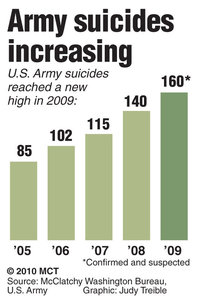
…This month, the Defense Department reported that there were 160 reported active-duty Army suicides in 2009, up from 140 in 2008. Of these, 114 have been confirmed, while the cause of death in the remaining 46 remains to be determined. The increase in military suicides includes men between the ages of 18-30, mid-career officers and, increasingly, women.

Adm. Mike Mullen, the chairman of the Joint Chiefs of Staff, and other military leaders have said the increase is likely related to repeated deployments in Iraq and Afghanistan and to the stigma long associated with seeking treatment for mental health problems.

…In response, the Pentagon has poured millions of dollars into new suicide prevention programs and thousands of hours on helping soldiers suffering from depression and post-traumatic stress disorder.”

If I may, the people at the Pentagon are treating the symptoms but not the disease. I can save them those millions of dollars and thousands of hours spent on seeking a solution to this problem with one simple prescription. It’s a great, big dose of  ‘Get the hell out of Iraq and Afghanistan and put an end to this perpetual state of war.’

Obama as "The Candidate"

Tags

, , ,

When I read Paul Krugman today, it brought to mind something that I’ve been thinking about off and on  for the last few months:

“…this is about the president. After Massachusetts, Democrats were looking for leadership; they didn’t get it. Ten days later, nobody is sure what Obama intends to do, and his aides are giving conflicting readings. It’s as if Obama checked out.

Look, Obama is a terrific speaker and a very smart guy. He really showed up the Republicans in the now-famous give-and-take. But we knew that. What’s now in question isn’t his ability to talk, it’s his ability to lead.”

More and more I have the sneaking suspicion that this conversation took place sometime on the night of November 4, 2008, with Barack Obama in the role of Bill McKay, the character portrayed by Robert Redford in the movie The Candidate. “What do we do now?” seems to be the operative phrase in the Obama administration.

Life imitates art.

Reduce the Deficit in a Recession? Hello 1937

Tags

, , , , , ,

From Bloomberg:

“President Barack Obama said reducing the federal budget deficit is “critical” to ensuring future growth as the U.S. economy recovers from the recession...Obama in his address today highlighted some of the measures he proposed in his Jan. 27 State of the Union address, including a three-year freeze on spending (see Deficit Peacocks) for some domestic programs (but certainly not the sacred cow MIC) and creation of bipartisan commission to draft deficit-reduction recommendations for Congress to consider.”

.

Ah yes, the old bi-partisan deficit-reduction commission. The place of refuge for the gutless politician who doesn’t want to go on the record with a controversial vote. D.C. CYA at it’s best.

Also President Obama, the old adage is that those who do not learn the lessons of history are doomed to repeat them. 1937 for example.

That was the year FDR listened to the fiscal hawks of his day and decided to cut spending and balance the federal budget, assuming that the worst of the Great Depression was over. The result? Unemployment rose again, the economic growth of the previous 3 years was reversed, and the country slid back into what became known as the “Roosevelt Recession.” The dreaded double-dip.

Lucy Holds the Football……Again

Tags

, ,

Some people never learn:

Sen. Olympia Snowe (R-Maine) said Friday that she has been in conversation with Democrats and Finance Committee Chairman Max Baucus about a way forward on health care reform.

“I have talked with several of my Democratic colleagues, including the chairman of the Finance Committee, just sorting through these issues, and the process, and what will unfold,” Snowe told Andrea Mitchell on MSNBC Friday afternoon.

…But Snowe made it very clear she could not support any form of a bill that came through the reconciliation process—a legislative move she called “wrong and untenable.”

Instead, Snowe believes Congress could pass a scaled-back version of insurance reform based on measures that would aid small business, a policy stance she has held since the summer with she voted in favor of the bill that came through the Finance Committee.”

Einstein was right.

Never Underestimate the Ignorance of the American Public

Tags

,

“If a nation expects to be ignorant and free in a state of civilization, it expects what never was and never will be.” –Thomas Jefferson 1816.

It’s a good thing TJ isn’t around to see the results of this January 18 Pew poll on political knowledge.

“The news quiz, conducted by the Pew Research Center for the People & the Press Jan. 14-17 among 1,003 adults reached on cell phones and landlines, asked 12 multiple choice questions on subjects ranging from economics and foreign affairs to prominent people in the news. Americans answered an average of 5.3 questions correctly.”

A few of the discouraging results:

* Only 26% knew that it takes 60 votes to break a filibuster in the Senate.

* 39% knew that Harry Reid is the Majority Leader in the Senate.

* 32% knew that the Senate version of health care reform passed without a single Republican vote.

* 32% could identify Michael Steele as the chairman of the Republican National Committee.

* 50% named Yemen as the country where the Christmas Day bomber received training.

* 43% knew that more Americans were killed in Afghanistan than Iraq in 2009.

* 36% could estimate the current level of the Dow Jones Industrial Average at about 10,000 points.

* 59% could name China as the country holding the most U.S. government debt.

I would like to see the poll results if the same group were asked who replaced Paula Abdul on American Idol, or the names of the cast members of Lost, or what is the location of this season’s Survivor. I’ll bet a week’s pay the numbers would be higher.

We Don’t Need No Stinkin’ Contingency Plan

Tags

, , ,

The danger of ass-u-me-ing, from TPMDC:

“The White House had no contingency plan for health care reform if Democrat Martha Coakley lost the special election in Massachusetts, and officials did not discuss the possibility a Democratic loss would dramatically imperil their legislative efforts, a top adviser said today.

…”There wasn’t much discussion about the implications if the thing went the other way,” he said.

President Obama’s senior advisor David Axelrod said there “wasn’t much discussion” about an alternative path to passing health care with just 59 Democrats in the Senate because there was “widespread assumption was that that seat was safe.”

Apparently, there are no former Boy Scouts in the president’s inner circle.

Whatever It Is, They’re Against It

Tags

, , ,

In response to President Obama’s call for bi-partisanship in his Wednesday night State of the Union address, the Republican reply on Thursday was this:

“The Senate took a vote on extending the federal debt ceiling — without which the United States would go into default. All 40 Republicans voted no.

The Senate took a vote on requiring Congress not to pass legislation that it can’t pay for. All 40 Republicans voted no.

The Senate took a final vote on passing the overall plan. Thirty-nine Republicans voted no. The 40th, Sen.Mike Enzi (R-Wyo) skipped the vote.”

Groucho, you’re on:

"Deficit Peacocks"

Tags

, , , ,

In his op-ed in Thursday’s New York Times Paul Krugman refers to Michael Linden’s piece at the Center for American Progress which makes the distinction between what he calls “deficit hawks” and “deficit peacocks.” Linden describes the hawks as, “those who believe that the long-term deficits pose serious risks, but that short-term deficits are necessary and wise during a recession” and “those who believe that deficits are always risky and should be avoided at all costs.”

The two have this is common:

“Both kinds of hawks are genuine in their concern over our nation’s finances and are sincerely committed to working toward a more sustainable federal budget.”

Then he turns to the “peacocks:”

“Deficit peacocks like to preen and call attention to themselves, but are not sincerely interested in taking the difficult but necessary steps toward a balanced budget. Peacocks prefer scoring political points to solving problems.”

Unfortunately, this category takes in the lion’s share of our elected officials in Washington–on both sides of the aisle–whose top priority is their own re-election, and who see those “difficult but necessary steps” as an impediment to that. After all, difficult choices are not often popular choices.

Linden then lists 4 ways to distinguish the hawks from the peacocks. Peacocks:

“1. Never mention revenues.
Increasing revenues is going to have to be part of the solution for meeting the fiscal challenge. Any suggestion that we can solve this problem solely by cutting spending reveals an utter misunderstanding or ignorance of the budget numbers. Balancing the budget without raising any additional revenue 10 years from now would require cutting every program in the entire budget by more than 25 percent, including all defense spending, Social Security and Medicare benefits, air-traffic-control funding, veterans’ benefits, aid to schools, job training programs, agriculture subsidies, highway maintenance, and everything else.

2. Offer easy answers.
We face a very large budget gap over the coming decade, and the scale of the problem is such that no one solution is going to solve it all. It is going to take a mix of increased revenues, spending reductions, and improved government efficiency to get our fiscal house in order. Those who claim that we could get the budget back to sustainability if we only cut out earmarks, or say that the solution is to simply freeze discretionary spending, are just peddling fiscal snake oil.”

(Note: this article is dated January 20, prior to President Obama’s State of the Union address)

“There are no easy answers to our budgetary challenges. We have an aging population, rising health care costs, and a tax code full of loopholes, exceptions, and targeted subsidies. It is going to take more than simple solutions to meet these challenges. If you hear the words, “all we have to do to balance the budget is…” then you know whoever spoke them hasn’t fully grasped the scope of the problem.

3. Support policies that make the long-term deficit problem worse.
Congress voted repeatedly over the past eight years to make huge tax cuts and create new spending programs without offsetting any of those costs. Many of the very same members of Congress who voted for those policies are now loudly urging the president to clean up the mess that they themselves made.

4. (Sorry, Sen. McCain, but facts is facts.) Think our budget woes appeared suddenly in January 2009.
More than 50 % of 2009’s huge deficit can be directly attributed to policies enacted by the previous administration, and that is not counting the 20 percent that was due to the economic disaster that began and gathered its momentum on President Bush’s watch. President Obama’s efforts to rescue the economy, on the other hand, are responsible for only 16 percent…The Bush-era tax cuts alone will add more than $5 trillion to the budget deficit over the next 10 years.”

Linden concludes:

“There are people from all parts of the political spectrum who strongly and sincerely believe that our current budget path is unsustainable and are committed to taking concrete steps to put the country on a better path. But there are also many who are only interested in scoring political points or in getting in the way of progress on this issue. Sometimes it can be difficult to distinguish between the two. Now, all you need to do to tell the former from the latter is apply any of these four handy tests.”

Obama DOJ: Authorizing Torture Just "Poor Judgment"

Tags

, , , , , ,

The Obama administration Department of Looking Forward, Not Back has come to the conclusion that the authorization of the use of “enhanced interrogation techniques” torture is nothing more than “poor judgement.” From Michael Isikoff and Daniel Klaidman at Newsweek:

“..an upcoming Justice Department report from its ethics-watchdog unit, the Office of Professional Responsibility (OPR), clears the Bush administration lawyers who authored the “torture” memos of professional-misconduct allegations.

While the probe is sharply critical of the legal reasoning used to justify waterboarding and other “enhanced” interrogation techniques, NEWSWEEK has learned that a senior Justice official who did the final review of the report softened an earlier OPR finding. Previously, the report concluded that two key authors—Jay Bybee, now a federal appellate court judge, and John Yoo, now a law professor—violated their professional obligations as lawyers when they crafted a crucial 2002 memo approving the use of harsh tactics, say two Justice sources who asked for anonymity discussing an internal matter. But the reviewer, career veteran David Margolis, downgraded that assessment to say they showed “poor judgment,” say the sources. (Under department rules, poor judgment does not constitute professional misconduct.) The shift is significant: the original finding would have triggered a referral to state bar associations for potential disciplinary action—which, in Bybee’s case, could have led to an impeachment inquiry.”

Meet the new DOJ, same as the old DOJ.