• About

Desperado's Outpost

Desperado's Outpost

Monthly Archives: April 2010

Typhoid Lloyd (Blankfein) Spread the Goldman “Poison”

27 Tuesday Apr 2010

Posted by Craig in economy, Financial Crisis, financial reform, financial regulation, Goldman Sachs, Politics, Wall Street

≈ Leave a comment

Tags

Carl Levin, Goldman Sachs, Lloyd Blankfein, mortgage securities, Senate Permanent Subcommittee on Investigations, shorting the market, subprime

By the summer of 2006, Goldman Sachs executives realized that the subprime mortgage market and its related securities were headed for a fall, “a very unhappy ending” as senior trader Michael Swenson wrote in a 2007 memo. They also knew their firm was heavily invested in this ticking time bomb.

What to do? The solution from Typhoid Lloyd (Blankfein) and the Goldman gang? Let’s find some suckers to dump this trash on, tell them it’s treasure, bet on it to fail, and rake in the dough.

And rake it in they did.

“The firm, which had profited handsomely off packaging and selling securitized subprime home mortgages to investors during the housing boom, switched directions in early 2007, furiously shedding its home mortgage-linked risk and buying as much insurance as it could, effectively shorting the market throughout the year — a move that netted the firm “billions and billions” at the expense of its clients, according to the documents released by the Senate Permanent Subcommittee on Investigations.

The firm was “spreading the poison throughout the system,” Levin charged.

“Goldman Sachs made billions of dollars from betting against the housing market, and it placed those bets in some cases at the same time it was selling mortgage-related securities to its clients,” said the committee’s chairman, Carl Levin (D-Mich.).”

Poison is the sanitized version. Goldman exec Tom Montag put the appropriate tag on it:

“One particular security, named Timberwolf I, a collateralized debt obligation of other collateralized debt obligations that were based not on actual home mortgage bonds but instead on those bonds’ movements, lost 80 percent of its value within five months of issuance. A senior executive…remarked in a June 22, 2007, email, “Boy, that timberwolf was one shi**y deal.”

Which is precisely what Goldman’s clients got—one shi**y deal.

A Crucial Week for Financial Reform

26 Monday Apr 2010

Posted by Craig in bailout, Congress, economy, Financial Crisis, financial reform, financial regulation, Obama, Politics, Republicans, too big to fail, Wall Street

≈ Leave a comment

Tags

Blanche Lincoln, Bob Corker, Chris Dodd, claw back, derivative legislation, financial reform, Goldman Sachs, great vampire squid, Harry Reid, letter, Mitch McConnell, Olympia Snowe, President Obama, Richard Shelby, Scott Brown, This Week

In what’s shaping up as a crucial week in the quest for financial reform there are some encouraging signs, some not so encouraging, and a demonstration by the executives at “the great vampire squid” (aka Goldman Sachs) give us an example of why meaningful reform is necessary.

First, the reasons to be hopeful. There appear to be some cracks in the Republican wall of solidarity. Sen. Olympia Snowe endorsed Sen. Blanche Lincoln’s tough stance toward derivative trading passed last week by the Agriculture Committee. (Sen. Grassley, another possible defector, was the lone Republican on the committee who voted for Lincoln’s proposal). In a letter to Majority Leader Harry Reid, Snowe wrote:

“I believe that strong derivatives regulation goes to the heart of an effective financial reform bill and that Chairman Lincoln’s legislation is a strong step towards realizing this fundamental component to financial reform……I believe that we should err on the side of caution and finally bring full transparency to these markets once and for all and allow regulators to preemptively identify these damaged firms.

“Accordingly, I believe the Senate should start with a comprehensive, strong derivatives reform proposal and defend attempts to weaken it, not the other way around and the legislation produced by the Senate Agriculture Committee includes the strongest safeguards and most robust transparency provisions on our expansive derivatives market.

I urge the Majority Leader to incorporate these provisions into the regulatory reform bill.”

On Friday, Sen. Chris Dodd, chairman of the Senate Banking Committee, “agreed to replace his proposed restrictions on derivatives with those of the Senate Agriculture Committee, chaired by Arkansas Democrat Blanche Lincoln.”

On This Week yesterday, Sen. Bob Corker said he intended to propose an amendment containing a “claw back” provision to the legislation “which would take away the personal earnings for the past five years of the corporate officers of failed institutions that fall under the government’s resolution authority.”

Another possible Republican defector might be the newly-elected senator from Massachusetts, Scott Brown. Will someone who was elected as a sort of “man of the people” want to be painted as a defender of Wall Street? Especially when he faces re-election in 2 years? Maybe not.

Also on the positive side, “President Obama and House Financial Services Chairman Barney Frank have personally urged Dodd not to cut a deal with Republicans…This is a welcome sign that Obama realizes that public opinion is moving in the direction of tougher banking reform, and that he learned from the health debate that bipartisan compromise on key reform issues is a snare and a delusion.”

Sen. Dodd has shown signs of weakening the legislation in order to compromise with Republicans leaders in the Senate, Mitch McConnell and Richard Shelby, who want to use the same tactics Republicans used on health care reform—stall and delay as long as possible. Hopefully, Dodd will be emboldened by support from President Obama and not dilute reform to try and pacify those whose intentions are to maintain the status quo.

Now to the crooks at Goldman. What were they doing as the housing market was collapsing and threatening to take the entire economy with it? Having a party:

“As the U.S. housing market began its epic fall nearly three years ago, top executives at Wall Street powerhouse Goldman Sachs cheered the large financial gains the firm stood to make on certain bets it had placed, according to newly released documents.

The documents show that the firm’s executives were celebrating earlier investments calculated to benefit if housing prices fell, a Senate investigative committee found. In an e-mail sent in the fall of 2007, for example, Goldman executive Donald Mullen predicted a windfall because credit-rating companies had downgraded mortgage-related investments, which caused losses for investors.

“Sounds like we will make some serious money,” Mullen wrote.”

To somewhat defend Goldman, what they were doing, “selling short,” (betting against certain investments) is something that happens on Wall Street every day. But, betting against instruments that they designed to fail, and which were sold to investors as AAA investments allowing Goldman to profit from on both ends, may not be illegal (although it should be) but it certainly shows that the execs at the “great vampire squid” have no interest in what’s best for the country. They have one party’s interests in mind—-their own.


William Black on Lehman Fraud

22 Thursday Apr 2010

Posted by Craig in economy, Financial Crisis, financial reform, financial regulation, too big to fail, Wall Street

≈ Leave a comment

Tags

fraud, House Financial Services Committee, Lehman Brothers, William Black

William Black, testifying before the House Financial Services Committee, on the fraud at Lehman Brothers. From Jesse’s Café Americain via Firedoglake:

Simon Johnson and James Kwak on Bill Moyers Journal

22 Thursday Apr 2010

Posted by Craig in bailout, Financial Crisis, financial reform, financial regulation, Politics, too big to fail, Wall Street

≈ Leave a comment

Tags

13 Bankers, Baseline Scenario, Bill Moyers Journal, Financial Crisis, James Kwak, Simon Johnson

Simon Johnson and James Kwak, co-authors of 13 Bankers and co-founders of Baseline Scenario discuss the financial crisis and the need to reform the system. From Crooks and Liars: Vodpod videos no longer available.

more about “Simon Johnson and James Kwak on Bill …“, posted with vodpod

Chickens for Checkups

22 Thursday Apr 2010

Posted by Craig in Politics, Republicans

≈ Leave a comment

Tags

Chickens for Checkups, Sue Lowden

Probably by now most everyone has heard the ridiculous statement by Sue Lowden, Senatorial candidate from Nevada, about “the olden days” when our grandparents would pay for their medical care with chickens or by offering to paint the doctor’s house. The DSCC has even launched a Chickens for Checkups page on their web site where messages can be sent to Mrs. Lowden asking her what the appropriate barter might be for a variety of ailments. For those who may have missed it :

Seriously, is this the best Nevada Republicans can do to come up with a challenger for Harry Reid?

Mrs. Lowden’s campaign web site doesn’t give her birthday, but it says she was second runner-up for Miss America in 1973, which means she was somewhere around 18 at the time. So if she was born in 1955, that would make her 55 years old now. Her parents have to be in their late 70’s or early 80’s, and her grandparents, if they are still alive, must be pushing or past 100, meaning they were born somewhere around 1910.

In the year 1910:

The average life expectancy was about 50 years.

Ninety percent of all doctors had no college education.

The leading causes of death in the U.S. were:
1. Pneumonia and influenza
2. Tuberculosis
3. Diarrhea

I think I’ll take modern medicine over the “olden days.” Even if I do have to pay in cash instead of farm animals.

The Most Dangerous Man in the World

20 Tuesday Apr 2010

Posted by Craig in bailout, economy, financial reform, financial regulation, Obama, Politics, too big to fail, Wall Street

≈ Leave a comment

Tags

Baseline Scenario, blackmail, German newspaper, interview, Jamie Dimon, JPMorgan Chase, Simon Johnson, The Most Dangerous Man in America, White House visitor log

In an April 3 post at Baseline Scenario, Simon Johnson called JPMorgan Chase CEO Jamie Dimon “The Most Dangerous Man in America.” Johnson wrote:

“There are two kinds of bankers to fear.  The first is incompetent and runs a big bank.  This includes such people as Chuck Prince (formerly of Citigroup) and Ken Lewis (Bank of America).  These people run their banks onto the rocks – and end up costing the taxpayer a great deal of money.  But, on the other hand, you can see them coming and, if we ever get the politics of bank regulation straightened out again, work hard to contain the problems they present.

The second type of banker is much more dangerous.  This person understands how to control risk within a massive organization, manage political relationships across the political spectrum, and generate the right kind of public relations.  When all is said and done, this banker runs a big bank and – here’s the danger – makes it even bigger.

Jamie Dimon is by far the most dangerous American banker of this or any other recent generation.”

Following an interview with German newspaper Welt am Sonntag on Sunday, that should be amended to read “the most dangerous man in the world” as Dimon issued this not-so-veiled threat on the possibility of stricter bank regulations:

“When profits fall too sharply then capital will move somewhere else, where there is more money to be earned, for example non-regulated markets. The question is, is that what regulators want?”

Blackmail, anyone?

“[Dimon] also said the banking industry could do with more influence on politicians.”

More influence? According to the White House log, since October 30, 2009 Mr. Dimon has made 8, count ‘em 8, visits. What do you want to do, Jamie? Move in?

Are Goldman Charges the Tip of the Iceberg?

19 Monday Apr 2010

Posted by Craig in bailout, economy, Financial Crisis, financial reform, financial regulation, Goldman Sachs, Politics, too big to fail, Wall Street

≈ Leave a comment

Tags

Countrywide, Dylan Ratigan, fraud, German government, Goldman Sachs, Gordon Brown, Lloyd Blankfein, Robert Khuzami, Securities and Exchange Commission

Could Friday’s news that the Securities and Exchange Commission is bringing civil charges of fraud against Goldman Sachs be the tip of the iceberg? Consider what has happened since then.

The German government is considering legal action against Goldman.

British Prime Minister Gordon Brown called for investigations into the bank’s role in the mortgage market.

“The SEC is investigating whether other mortgage deals arranged by some of Wall Street’s biggest firms may have crossed the line into misleading investors.

S.E.C. Enforcement Director Robert Khuzami told CNBC, “We have brought and will continue to pursue cases involving the products and practices related to the financial crisis.” … a wide range of cases are currently being investigated.”

Subprime mortgage king Countrywide is also in the crosshairs:

“Federal criminal investigators looking into the collapse of Countrywide Financial Corp. have been calling witnesses before a grand jury, say people familiar with the matter.”

Former Goldman employees are starting to talk, implicating company execs up to and including CEO Lloyd Blankfein in Goldman’s profiting from the housing market collapse.

Dylan Ratigan has a basic explanation of what Goldman and others were doing. The analogy goes like this—they were selling cars with faulty brakes and then taking out life insurance policies on the people to whom those cars were sold.

But it was even more sinister than that. Goldman not only sold the car with faulty brakes, while telling the buyers that the brakes were good, they designed the car to have faulty brakes, knowing that it was going to crash at some point. So they profited on both ends, selling the car they knew would crash and then collecting the life insurance when it crashed.

Those who are quick to dismiss the charges against Goldman as a tempest in a teapot, something that will quickly blow over after the firm pays a small (relative to their size) fine and goes on their merry way should remember this. It was a night watchman who found a piece of tape on a lock on a door at the Watergate Hotel which led to an investigation which culminated in the resignation of a president.

The question now is do we have a modern-day Woodward and Bernstein? Do we have a modern-day Ben Bradlee who will defy the powers that be and publish the information those reporters uncover in spite of the possible repercussions that those powers may bring to bear? Do we have a modern-day Sam Ervin in Congress? Is there a modern-day John Dean? An ethical person with inside knowledge of the activities at Goldman and other Wall Street giants who is willing to talk?

Time will tell.

Dumb and Dumber

18 Sunday Apr 2010

Posted by Craig in bailout, economy, financial reform, financial regulation, Goldman Sachs, Politics, too big to fail, Wall Street

≈ Leave a comment

Tags

endless taxpayer bailouts, Goldman Sachs, John Boehner, Mitch McConnell, Newshoggers. Frank Luntz, Ron Beasley, SEC, Steve Benen, talking points, Washington Monthly

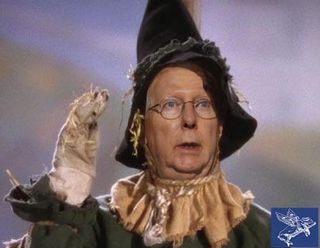
Ron Beasley at Newshoggers has the appropriate image of Senator Mitch McConnell in his post yesterday entitled, “If He Only Had a Brain” :

McConnell continues to mindlessly repeat Frank Luntz talking points about “endless taxpayer bailouts of Wall Street banks,” talking points written before there was an actual bill. Rachel Maddow compares the similarity, purely coincidental I’m sure, between Luntz’s “words to use” and McConnell’s statements:

Speaking of mindless, there’s McConnell’s sidekick, Congressman John Boner Boehner. After Friday’s news that the SEC was suing Goldman Sachs for fraud, Boner Boehner released a statement, “calling the firm a “key supporter” of the president’s bid to reform the nation’s financial regulatory system.”

“These are very serious charges against a key supporter of President Obama’s bill to create a permanent Wall Street bailout fund,” Boehner said Friday in the statement. “Despite President Obama’s rhetoric, his permanent bailout bill gives Goldman Sachs and other big Wall Street banks a permanent, taxpayer-funded safety net by designating them ‘too big to fail.’ Just whose side is President Obama on?”

Steve Benen at Washington Monthly:

“To hear the dim-witted Minority Leader put it, the Obama administration and Goldman Sachs are close allies, and the administration-backed reform bill is intended to help firms like Goldman Sachs. And we now know for sure that administration officials are carrying water for Goldman Sachs because … they just charged Goldman Sachs with fraud.

What?

I’m trying to imagine the conversation in Boehner’s office when the statement was being written. Which genius on Boehner’s staff discovered that the Obama administration is going after Goldman Sachs, regardless of its campaign contributions to Obama, and thought, “A ha! Now we’ve got ’em!“

I would guess that genius was the Orangeman himself.

Whatever It Is, They’re Against It

17 Saturday Apr 2010

Posted by Craig in bailout, Congress, economy, financial reform, financial regulation, Politics, special interests, too big to fail, Wall Street

≈ Leave a comment

Tags

$50 billion fund, American Banker, Bob Corker, dismantle, endless taxpayer bailouts, FDIC, financial reform, Frank Luntz memo, Harry Reid, letter, Mitch McConnell, Sheila Bair, Susan Collins

Senator Mitch McConnell (R-KY), speaking for all 41 Senate Republicans on the prospects for reforming and regulating the financial system:

That was after Susan Collins (R-ME) became the 41st signature on McConnell’s letter to Harry Reid which reads:

“We are united in our opposition to the partisan legislation reported by the Senate Banking Committee. As currently constructed, this bill allows for endless taxpayer bailouts of Wall Street and establishes new and unlimited regulatory powers that will stifle small businesses and community banks.”

All words straight out of a Frank Luntz memo, telling Republicans how to maintain the status quo while sounding like they are in favor of reform. In other words, just repeat the Luntz-inspired tactics from the health care debate, with “endless taxpayer bailouts” replacing “death panels” as the lie du jour. And a lie is exactly what it is. What will guarantee “endless taxpayer bailouts” is doing nothing. The proposed reform calls for applying the same process to the “too big to fail” institutions that the FDIC uses every day for dealing with banks that become insolvent.

Sheila Bair, head of the FDIC, and whose word I’ll take over McConnell’s 8 days a week, said as much in an interview published at American Banker on Thursday:

Would this bill perpetuate bailouts?
SHEILA BAIR: The status quo is bailouts. That’s what we have now. If you don’t do anything, you are going to keep having bailouts.

But does this bill stop them from happening?
BAIR: It makes them impossible and it should. We worked really hard to squeeze bailout language out of this bill. The construct is you can’t bail out an individual institution – you just can’t do it.

If this had been law prior to 2008, would we have seen the bailouts that took place?
BAIR: No. You could not do an AIG, Bear Stearns, or any of that…This bill would only allow system-wide liquidity support which could not be targeted at an individual firm. You can’t do capital investments at all, period. It’s only liquidity support. No more capital investments. That’s banned under all circumstances.

Do you see any way left for the government to bail out a financial institution?
BAIR: No, and that’s the whole idea. It was too easy for institutions to come and ask for help. They aren’t going to do that. This gives us a response: “Fine, we will take all these essential services and put them in a bridge bank. We will keep them running while your shareholders and debtors take all your losses. And oh, by the way, we are getting rid of your board and you, too.”

Here’s all you need to know about the dishonesty of Senate Republicans. One provision of the bill is for a $50 billion fund to dismantle the “too big to fail” banks. The fund is made up entirely of money which comes from the big banks, not one thin dime from the taxpayers. Republicans want this provision removed. But even if it goes, will they support the remainder of the legislation? I think you can guess the answer:

“McConnell suggested it wouldn’t be enough to satisfy Republicans.

“I appreciate the Obama administrations recognition of the need to substantively improve this bill,” McConnell said. “And I hope we can work with them to close the remaining bailout loopholes that put American taxpayers on the hook for financial institutions that become too big to fail.”

Oh by the way, how did the $50 billion get into the legislation to begin with? It was the result of negotiations between Banking Committee members Mark Warner (D-VA) and Bob Corker (R-TN). Needless to say, Corker now opposes the fund he negotiated to include.

Whatever it is, they’re against it.

Jail the Banksters!

14 Wednesday Apr 2010

Posted by Craig in bailout, economy, Financial Crisis, financial reform, Politics, too big to fail, Wall Street

≈ Leave a comment

Tags

antitrust case, co-conspirators, Enron, Fastow, fraud, fraudulent loans, Hudson Castle, JPMorgan Chase, Karl Denninger, Lay, Lehman Brothers, Levin, Market Ticker, Skilling, Washington Mutual

The recent revelations about the goings-on at Washington Mutual bring back an old question about our friends the banksters. When is somebody going to jail? How about just charged and indicted? Something.

“Officials at the failed banking operations of Washington Mutual Inc. securitized substantial volumes of risky, fraudulent loans in the run-up to the financial meltdown despite repeated internal warning signs, according to a Senate probe.

The subcommittee has obtained documents showing that “at a critical point Washington Mutual included loans in its securities because they were likely to suffer a high rate of default, and they failed to disclose that to the buyers,” Sen. Levin said. “They also allowed loans that had been identified as fraudulent to be sold to buyers, again without alerting buyers when the fraud was discovered.”

Isn’t fraud a crime? Why are these executives testifying before Congress and not in a court of law? But then again, where else but the Wall Street bizarro world is this possible ?:

“March 26 (Bloomberg) — JPMorgan Chase & Co., Lehman Brothers Holdings Inc. and UBS AG were among more than a dozen Wall Street firms involved in a conspiracy to pay below-market interest rates to U.S. state and local governments on investments, according to documents filed in a U.S. Justice Department criminal antitrust case.

A government list of previously unidentified “co- conspirators” contains more than two dozen bankers at firms also including Bank of America Corp., Bear Stearns Cos., Societe Generale, two of General Electric Co.’s financial businesses and Salomon Smith Barney, the former unit of Citigroup Inc., according to documents filed in U.S. District Court in Manhattan on March 24.

…None of the firms or individuals named on the list has been charged with wrongdoing.”

Or what about this at Lehman Brothers?

“In the years before its collapse, Lehman used a small company — its “alter ego,” in the words of a former Lehman trader — to shift investments off its books.

The firm, called Hudson Castle, played a crucial, behind-the-scenes role at Lehman, according to an internal Lehman document and interviews with former employees. The relationship raises new questions about the extent to which Lehman obscured its financial condition before it plunged into bankruptcy.”

Isn’t that pretty much what Lay, Skilling, and Fastow were doing at Enron? So why no perp walks yet for the former execs at Lehman?

In the JPMorgan–Jefferson County scam, the crooked politicians went to jail, the banksters took the money and ran. Somebody say double standard?

Karl Denninger at Market Ticker nails it:

“The only deterrent available is to start throwing the scammers in prison.  All of them.  We can start with the people at WaMu and Lehman, then go down the list and for each and every firm that cooked its balance sheet, nailing them under SarBox  [Sarbanes-Oxley] as well.  While we’re at it jail every bank executive involved in crooked derivatives deals with municipal and state governments, starting with Jefferson County in Alabama.”

Amen.

← Older posts
Newer posts →

Recent Posts

  • Turn Out the Lights, the Revolution’s Over
  • Climbing Aboard the Hillary Train
  • You Say You Want a Revolution…
  • Proud to be a War Criminal
  • Drug Testing Welfare Applicants Struck Down in Florida

Archives

  • March 2016
  • February 2016
  • January 2016
  • April 2014
  • January 2014
  • April 2012
  • March 2012
  • February 2012
  • August 2011
  • July 2011
  • June 2011
  • January 2011
  • December 2010
  • November 2010
  • October 2010
  • September 2010
  • July 2010
  • June 2010
  • May 2010
  • April 2010
  • March 2010
  • February 2010
  • January 2010
  • December 2009
  • July 2009
  • June 2009
  • May 2009
  • April 2009
  • March 2009
  • January 2009
  • December 2008
  • November 2008
  • October 2008
  • September 2008
  • August 2008

Blogroll

  • Bankster USA
  • Down With Tyranny
  • Firedoglake
  • Memeorandum
  • naked capitalism
  • Newshoggers
  • Obsidian Wings
  • Taylor Marsh
  • The Market Ticker
  • Tom Dispatch
  • Zero Hedge

Categories

Enter your email address to subscribe to this blog and receive notifications of new posts by email.

Join 7 other subscribers
  • RSS - Posts
  • RSS - Comments

Create a free website or blog at WordPress.com.

Privacy & Cookies: This site uses cookies. By continuing to use this website, you agree to their use.
To find out more, including how to control cookies, see here: Cookie Policy
  • Subscribe Subscribed
    • Desperado's Outpost
    • Already have a WordPress.com account? Log in now.
    • Desperado's Outpost
    • Subscribe Subscribed
    • Sign up
    • Log in
    • Report this content
    • View site in Reader
    • Manage subscriptions
    • Collapse this bar
 

Loading Comments...