
• About

Desperado's Outpost

Desperado's Outpost

Category Archives: Wall Street

The Most Dangerous Man in the World

20 Tuesday Apr 2010

Posted by Craig in bailout, economy, financial reform, financial regulation, Obama, Politics, too big to fail, Wall Street

≈ Leave a comment

Tags

Baseline Scenario, blackmail, German newspaper, interview, Jamie Dimon, JPMorgan Chase, Simon Johnson, The Most Dangerous Man in America, White House visitor log

In an April 3 post at Baseline Scenario, Simon Johnson called JPMorgan Chase CEO Jamie Dimon “The Most Dangerous Man in America.” Johnson wrote:

“There are two kinds of bankers to fear.  The first is incompetent and runs a big bank.  This includes such people as Chuck Prince (formerly of Citigroup) and Ken Lewis (Bank of America).  These people run their banks onto the rocks – and end up costing the taxpayer a great deal of money.  But, on the other hand, you can see them coming and, if we ever get the politics of bank regulation straightened out again, work hard to contain the problems they present.

The second type of banker is much more dangerous.  This person understands how to control risk within a massive organization, manage political relationships across the political spectrum, and generate the right kind of public relations.  When all is said and done, this banker runs a big bank and – here’s the danger – makes it even bigger.

Jamie Dimon is by far the most dangerous American banker of this or any other recent generation.”

Following an interview with German newspaper Welt am Sonntag on Sunday, that should be amended to read “the most dangerous man in the world” as Dimon issued this not-so-veiled threat on the possibility of stricter bank regulations:

“When profits fall too sharply then capital will move somewhere else, where there is more money to be earned, for example non-regulated markets. The question is, is that what regulators want?”

Blackmail, anyone?

“[Dimon] also said the banking industry could do with more influence on politicians.”

More influence? According to the White House log, since October 30, 2009 Mr. Dimon has made 8, count ‘em 8, visits. What do you want to do, Jamie? Move in?
Are Goldman Charges the Tip of the Iceberg?

19 Monday Apr 2010

Posted by Craig in bailout, economy, Financial Crisis, financial reform, financial regulation, Goldman Sachs, Politics, too big to fail, Wall Street

≈ Leave a comment

Tags

Countrywide, Dylan Ratigan, fraud, German government, Goldman Sachs, Gordon Brown, Lloyd Blankfein, Robert Khuzami, Securities and Exchange Commission

Could Friday’s news that the Securities and Exchange Commission is bringing civil charges of fraud against Goldman Sachs be the tip of the iceberg? Consider what has happened since then.

The German government is considering legal action against Goldman.

British Prime Minister Gordon Brown called for investigations into the bank’s role in the mortgage market.

“The SEC is investigating whether other mortgage deals arranged by some of Wall Street’s biggest firms may have crossed the line into misleading investors.

S.E.C. Enforcement Director Robert Khuzami told CNBC, “We have brought and will continue to pursue cases involving the products and practices related to the financial crisis.” … a wide range of cases are currently being investigated.”

Subprime mortgage king Countrywide is also in the crosshairs:

“Federal criminal investigators looking into the collapse of Countrywide Financial Corp. have been calling witnesses before a grand jury, say people familiar with the matter.”

Former Goldman employees are starting to talk, implicating company execs up to and including CEO Lloyd Blankfein in Goldman’s profiting from the housing market collapse.

Dylan Ratigan has a basic explanation of what Goldman and others were doing. The analogy goes like this—they were selling cars with faulty brakes and then taking out life insurance policies on the people to whom those cars were sold.

But it was even more sinister than that. Goldman not only sold the car with faulty brakes, while telling the buyers that the brakes were good, they designed the car to have faulty brakes, knowing that it was going to crash at some point. So they profited on both ends, selling the car they knew would crash and then collecting the life insurance when it crashed.

Those who are quick to dismiss the charges against Goldman as a tempest in a teapot, something that will quickly blow over after the firm pays a small (relative to their size) fine and goes on their merry way should remember this. It was a night watchman who found a piece of tape on a lock on a door at the Watergate Hotel which led to an investigation which culminated in the resignation of a president.

The question now is do we have a modern-day Woodward and Bernstein? Do we have a modern-day Ben Bradlee who will defy the powers that be and publish the information those reporters uncover in spite of the possible repercussions that those powers may bring to bear? Do we have a modern-day Sam Ervin in Congress? Is there a modern-day John Dean? An ethical person with inside knowledge of the activities at Goldman and other Wall Street giants who is willing to talk?

Time will tell.

Dumb and Dumber

18 Sunday Apr 2010

Posted by Craig in bailout, economy, financial reform, financial regulation, Goldman Sachs, Politics, too big to fail, Wall Street

≈ Leave a comment

Tags

endless taxpayer bailouts, Goldman Sachs, John Boehner, Mitch McConnell, Newshoggers. Frank Luntz, Ron Beasley, SEC, Steve Benen, talking points, Washington Monthly

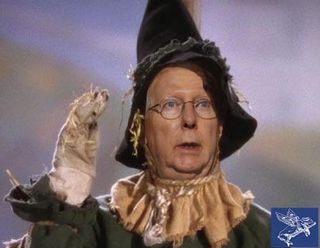
Ron Beasley at Newshoggers has the appropriate image of Senator Mitch McConnell in his post yesterday entitled, “If He Only Had a Brain” :

McConnell continues to mindlessly repeat Frank Luntz talking points about “endless taxpayer bailouts of Wall Street banks,” talking points written before there was an actual bill. Rachel Maddow compares the similarity, purely coincidental I’m sure, between Luntz’s “words to use” and McConnell’s statements:

Speaking of mindless, there’s McConnell’s sidekick, Congressman John Boner Boehner. After Friday’s news that the SEC was suing Goldman Sachs for fraud, Boner Boehner released a statement, “calling the firm a “key supporter” of the president’s bid to reform the nation’s financial regulatory system.”

“These are very serious charges against a key supporter of President Obama’s bill to create a permanent Wall Street bailout fund,” Boehner said Friday in the statement. “Despite President Obama’s rhetoric, his permanent bailout bill gives Goldman Sachs and other big Wall Street banks a permanent, taxpayer-funded safety net by designating them ‘too big to fail.’ Just whose side is President Obama on?”

Steve Benen at Washington Monthly:

“To hear the dim-witted Minority Leader put it, the Obama administration and Goldman Sachs are close allies, and the administration-backed reform bill is intended to help firms like Goldman Sachs. And we now know for sure that administration officials are carrying water for Goldman Sachs because … they just charged Goldman Sachs with fraud.

What?

I’m trying to imagine the conversation in Boehner’s office when the statement was being written. Which genius on Boehner’s staff discovered that the Obama administration is going after Goldman Sachs, regardless of its campaign contributions to Obama, and thought, “A ha! Now we’ve got ’em!“

I would guess that genius was the Orangeman himself.

Whatever It Is, They’re Against It

17 Saturday Apr 2010

Posted by Craig in bailout, Congress, economy, financial reform, financial regulation, Politics, special interests, too big to fail, Wall Street

≈ Leave a comment

Tags

$50 billion fund, American Banker, Bob Corker, dismantle, endless taxpayer bailouts, FDIC, financial reform, Frank Luntz memo, Harry Reid, letter, Mitch McConnell, Sheila Bair, Susan Collins

Senator Mitch McConnell (R-KY), speaking for all 41 Senate Republicans on the prospects for reforming and regulating the financial system:

That was after Susan Collins (R-ME) became the 41st signature on McConnell’s letter to Harry Reid which reads:

“We are united in our opposition to the partisan legislation reported by the Senate Banking Committee. As currently constructed, this bill allows for endless taxpayer bailouts of Wall Street and establishes new and unlimited regulatory powers that will stifle small businesses and community banks.”

All words straight out of a Frank Luntz memo, telling Republicans how to maintain the status quo while sounding like they are in favor of reform. In other words, just repeat the Luntz-inspired tactics from the health care debate, with “endless taxpayer bailouts” replacing “death panels” as the lie du jour. And a lie is exactly what it is. What will guarantee “endless taxpayer bailouts” is doing nothing. The proposed reform calls for applying the same process to the “too big to fail” institutions that the FDIC uses every day for dealing with banks that become insolvent.

Sheila Bair, head of the FDIC, and whose word I’ll take over McConnell’s 8 days a week, said as much in an interview published at American Banker on Thursday:

Would this bill perpetuate bailouts?
SHEILA BAIR: The status quo is bailouts. That’s what we have now. If you don’t do anything, you are going to keep having bailouts.

But does this bill stop them from happening?
BAIR: It makes them impossible and it should. We worked really hard to squeeze bailout language out of this bill. The construct is you can’t bail out an individual institution – you just can’t do it.

If this had been law prior to 2008, would we have seen the bailouts that took place?
BAIR: No. You could not do an AIG, Bear Stearns, or any of that…This bill would only allow system-wide liquidity support which could not be targeted at an individual firm. You can’t do capital investments at all, period. It’s only liquidity support. No more capital investments. That’s banned under all circumstances.

Do you see any way left for the government to bail out a financial institution?
BAIR: No, and that’s the whole idea. It was too easy for institutions to come and ask for help. They aren’t going to do that. This gives us a response: “Fine, we will take all these essential services and put them in a bridge bank. We will keep them running while your shareholders and debtors take all your losses. And oh, by the way, we are getting rid of your board and you, too.”

Here’s all you need to know about the dishonesty of Senate Republicans. One provision of the bill is for a $50 billion fund to dismantle the “too big to fail” banks. The fund is made up entirely of money which comes from the big banks, not one thin dime from the taxpayers. Republicans want this provision removed. But even if it goes, will they support the remainder of the legislation? I think you can guess the answer:

“McConnell suggested it wouldn’t be enough to satisfy Republicans.

“I appreciate the Obama administrations recognition of the need to substantively improve this bill,” McConnell said. “And I hope we can work with them to close the remaining bailout loopholes that put American taxpayers on the hook for financial institutions that become too big to fail.”

Oh by the way, how did the $50 billion get into the legislation to begin with? It was the result of negotiations between Banking Committee members Mark Warner (D-VA) and Bob Corker (R-TN). Needless to say, Corker now opposes the fund he negotiated to include.

Whatever it is, they’re against it.

Jail the Banksters!

14 Wednesday Apr 2010

Posted by Craig in bailout, economy, Financial Crisis, financial reform, Politics, too big to fail, Wall Street

≈ Leave a comment

Tags

antitrust case, co-conspirators, Enron, Fastow, fraud, fraudulent loans, Hudson Castle, JPMorgan Chase, Karl Denninger, Lay, Lehman Brothers, Levin, Market Ticker, Skilling, Washington Mutual

The recent revelations about the goings-on at Washington Mutual bring back an old question about our friends the banksters. When is somebody going to jail? How about just charged and indicted? Something.

“Officials at the failed banking operations of Washington Mutual Inc. securitized substantial volumes of risky, fraudulent loans in the run-up to the financial meltdown despite repeated internal warning signs, according to a Senate probe.

The subcommittee has obtained documents showing that “at a critical point Washington Mutual included loans in its securities because they were likely to suffer a high rate of default, and they failed to disclose that to the buyers,” Sen. Levin said. “They also allowed loans that had been identified as fraudulent to be sold to buyers, again without alerting buyers when the fraud was discovered.”

Isn’t fraud a crime? Why are these executives testifying before Congress and not in a court of law? But then again, where else but the Wall Street bizarro world is this possible ?:

“March 26 (Bloomberg) — JPMorgan Chase & Co., Lehman Brothers Holdings Inc. and UBS AG were among more than a dozen Wall Street firms involved in a conspiracy to pay below-market interest rates to U.S. state and local governments on investments, according to documents filed in a U.S. Justice Department criminal antitrust case.

A government list of previously unidentified “co- conspirators” contains more than two dozen bankers at firms also including Bank of America Corp., Bear Stearns Cos., Societe Generale, two of General Electric Co.’s financial businesses and Salomon Smith Barney, the former unit of Citigroup Inc., according to documents filed in U.S. District Court in Manhattan on March 24.

…None of the firms or individuals named on the list has been charged with wrongdoing.”

Or what about this at Lehman Brothers?

“In the years before its collapse, Lehman used a small company — its “alter ego,” in the words of a former Lehman trader — to shift investments off its books.

The firm, called Hudson Castle, played a crucial, behind-the-scenes role at Lehman, according to an internal Lehman document and interviews with former employees. The relationship raises new questions about the extent to which Lehman obscured its financial condition before it plunged into bankruptcy.”

Isn’t that pretty much what Lay, Skilling, and Fastow were doing at Enron? So why no perp walks yet for the former execs at Lehman?

In the JPMorgan–Jefferson County scam, the crooked politicians went to jail, the banksters took the money and ran. Somebody say double standard?

Karl Denninger at Market Ticker nails it:

“The only deterrent available is to start throwing the scammers in prison.  All of them.  We can start with the people at WaMu and Lehman, then go down the list and for each and every firm that cooked its balance sheet, nailing them under SarBox  [Sarbanes-Oxley] as well.  While we’re at it jail every bank executive involved in crooked derivatives deals with municipal and state governments, starting with Jefferson County in Alabama.”

Amen.

The “Secret Channel” at Lehman Brothers

13 Tuesday Apr 2010

Posted by Craig in bailout, economy, Financial Crisis, Politics, Wall Street

≈ Leave a comment

Tags

alter ego, Lehman Brothers, New York Times, shadow banking, Wall Street

Today’s New York Times has an account of a Lehman Brothers “alter ego” firm, Hudson Castle, part of the “vast financial system that operates in the shadows of Wall Street”:

“It was like a hidden passage on Wall Street, a secret channel that enabled billions of dollars to flow through Lehman Brothers.

In the years before its collapse, Lehman used a small company — its “alter ego,” in the words of a former Lehman trader — to shift investments off its books.

“Entities like Hudson Castle are part of a vast financial system that operates in the shadows of Wall Street, largely beyond the reach of banking regulators. These entities enable banks to exchange investments for cash to finance their operations and, at times, make their finances look stronger than they are.”

The firm, called Hudson Castle, played a crucial, behind-the-scenes role at Lehman, according to an internal Lehman document and interviews with former employees. The relationship raises new questions about the extent to which Lehman obscured its financial condition before it plunged into bankruptcy.

[…]

And sadly, it’s still going on:

“Even now, a year and a half after Lehman’s collapse, major banks still undertake such transactions with businesses whose names, like Hudson Castle’s, are rarely mentioned outside of footnotes in financial statements, if at all.”

Who Says Crime Doesn’t Pay?

12 Monday Apr 2010

Posted by Craig in AIG, bailout, economy, Financial Crisis, financial reform, financial regulation, Politics, too big to fail, Wall Street

≈ Leave a comment

Tags

AIG, banksters, bonuses, Charles Prince, Citigroup, Financial Crisis Inquiry Commission, Joseph Cassano

Who says crime doesn’t pay? If you happen to be a bankster or the crook who caused the collapse at AIG which, but for $182 billion courtesy of that never-ending ATM known as the American taxpayer, nearly led to the meltdown of our entire financial system, it pays like a Las Vegas slot machine. Consider the cases of Charles Prince, former Citigroup CEO, and Joseph Cassano, former head of AIG’s Financial Products Unit.

At last week’s Financial Crisis Inquiry Commission hearings Prince expressed his regret:

“I’m sorry that the financial crisis has had such a devastating impact on our country. I’m sorry for the millions of people, average Americans, who have lost their homes. And I’m sorry that our management team, starting with me, like so many others, could not see the unprecedented market collapse that lay before us.”

But not sorry enough to give back any of his ill-gotten gain from 2007 (emphasis added) :

“Prince, arguably the person most responsible for Citigroup’s enormous problems, can expect at least a $12.5 million cash bonus, compared with last year’s cash payout of $13.8 million.

And as he awaits his official retirement next month, Prince can rest assured that he will leave with $68 million, including his salary and accumulated stockholdings; a $1.7 million pension; an office, car and driver for up to five years — all in addition to the bonus. That is on top of $53.1 million he has taken home in the last four years, a period when $64 billion in the company’s market value has evaporated.”

However, Mr. Prince is a pauper compared to the HCIC (head crook in charge) at AIG, Joseph Cassano:

“Joseph Cassano was the head of AIG’s Financial Products Unit. They are the ones that made about a trillion dollars worth of bets in credit default swaps. They lost.

So, what happened to Cassano? This was all his idea and his team that brought on this colossal collapse. Well, he was fired! Great, justice served…Oh, did I forget to mention one thing? He received $35 million in bonuses when he was let go.”

…When they lost the bets, their company was devastated. Completely and utterly bankrput. The failure was so large, it promised to drag down the rest of the global economy with it. This forced the government to step in and cover their losses. So far, the United States taxpayers have put in $182 billion to keep AIG afloat.

That 35 mil was only tip money for Cassano:

“How much did he make for himself from 2000 to 2008 by gambling with the company’s money? Only $280 million…In the end, he walked away with over $315 million for destroying the company and maybe the whole economy.”

All that and no accountability required:

“This week the Wall Street Journal reported that prosecutors will likely not charge him with fraud. They are not going to try for clawbacks to get some of the money back. In the end, he gets away scott-free. But it’s better than free, he gets to keep all the money he never really made in the first place…”

The best way to rob a bank is to become a banker.

Banksters Up To Their Old Tricks

09 Friday Apr 2010

Posted by Craig in bailout, economy, Financial Crisis, Politics, Wall Street

≈ Leave a comment

Tags

Bank of America, Federal Reserve, Goldman Sachs, hiding, JP Morgan, Morgan Stanley, risk, Wall Street

Wall Street is up to its old tricks again, juggling the books to make their levels of debt appear lower at the end of the quarter which….drum roll please….increases their bonuses:

“Goldman Sachs, Morgan Stanley, J.P. Morgan Chase, Bank of America and Citigroup are the big names among 18 banks revealed by data from the Federal Reserve Bank of New York to be hiding their risk levels in the past five quarters by lowering the amount of leverage on the balance sheet before making it available to the public, The Wall Street Journal reported.

…There is nothing illegal about the practice, though it means that much of the time investors can have little idea of the risks the any bank is really taking.”

…“You want your leverage to look better at quarter-end than it actually was during the quarter, to suggest that you’re taking less risk,” William Tanona, a former Goldman analyst and current head of U.S. financials research at Collins Stewart, told The Journal.

Some things never change.

Dylan Ratigan on “The Great Con Job”

08 Thursday Apr 2010

Posted by Craig in bailout, economy, Financial Crisis, financial reform, financial regulation, Politics, Wall Street

≈ Leave a comment

Tags

Alan Grayson, Dylan Ratigan, MSNBC, The Great Con Job, Zero Hedge

Dylan Ratigan and Alan Grayson yesterday on MSNBC detail The Great Con Job, and the perpetrators of the con; the unholy alliance of the banksters, the Federal Reserve, and our alleged representatives in Washington, D.C. From Zero Hedge:

Vodpod videos no longer available.

more about “Dylan Ratigan, The Great Con Job“, posted with vodpod

Alan Greenspan and the “Everybody Missed It” Myth

05 Monday Apr 2010

Posted by Craig in bailout, economy, Financial Crisis, financial reform, financial regulation, Politics, too big to fail, Wall Street

≈ Leave a comment

Tags

Alan Greenspan, ARM, Bernanke, Bruce Bartlett, Geithner, home prices, housing bubble, Lehman Brothers, Long Term Capital Management, missed it, Paul Krugman, This Week

On ABC’s This Week yesterday former Fed Chairman Alan Greenspan once again pulled out the “nobody saw it coming” excuse for missing the conditions which led to the financial meltdown in 2008:

“…the reason it was missed is we have had no experience of the type of risks that arose following the default of Lehman Brothers in September 2008.That’s the critical mistake. And I made it. Everybody that I know who works in this business made it.”

False on many fronts. First, the “no experience” myth. The collapse of Lehman Brothers in 2008 was predictable, or should have been, by the failure of Long Term Capital Management in 1998 because both were brought about by similar business practices. Both had debt that far exceeded their assets and both were major players in the mortgage backed securities “shadow market.”

The other thing that “everyone” missed, according to Greenspan and his fellow revisionists anyway, and what was driving the mortgage backed securities explosion, was the housing bubble. Again false. Economists from Paul Krugman on the left to Reagan administration Treasury Department official Bruce Bartlett on the right were warning of the impending disaster in the housing market.

But putting aside economists for a minute, it shouldn’t have taken a Nobel Prize in economics to see that a 50% increase in home prices from 1995-2005 was unsustainable. Or that giving a $500,000 loan to someone with no documented income was not a good idea. Or that adjustable rate mortgages, 100% financing, interest-only loans, and all the other exotic mortgage variations were an accident looking for a time to happen. What was Greenspan saying at the time?

“Federal Reserve Chairman Alan Greenspan said Monday that Americans’ preference for long-term, fixed-rate mortgages means many are paying more than necessary for their homes and suggested consumers would benefit if lenders offered more alternatives…He said a Fed study suggested many homeowners could have saved tens of thousands of dollars in the last decade if they had ARMs.”

No, Mr. Greenspan, not “everybody” missed it. YOU missed it. You and the disciples of the group-think mentality in Washington who were afraid to buck you because of your position as the alleged “Maestro” and “Wizard” who was responsible for the supposedly booming economy which was in reality a house of cards. Unfortunately two of those disciples, Ben Bernanke and Timothy Geithner, are still in decision-making positions.

Just as a side note, there could be some fireworks at the Financial Crisis Commission hearings this week. Greenspan is set to testify on Wednesday and Don Robert Rubin-leone is up on Thursday.

← Older posts
Newer posts →

Recent Posts

  • Turn Out the Lights, the Revolution’s Over
  • Climbing Aboard the Hillary Train
  • You Say You Want a Revolution…
  • Proud to be a War Criminal
  • Drug Testing Welfare Applicants Struck Down in Florida

Archives

  • March 2016
  • February 2016
  • January 2016
  • April 2014
  • January 2014
  • April 2012
  • March 2012
  • February 2012
  • August 2011
  • July 2011
  • June 2011
  • January 2011
  • December 2010
  • November 2010
  • October 2010
  • September 2010
  • July 2010
  • June 2010
  • May 2010
  • April 2010
  • March 2010
  • February 2010
  • January 2010
  • December 2009
  • July 2009
  • June 2009
  • May 2009
  • April 2009
  • March 2009
  • January 2009
  • December 2008
  • November 2008
  • October 2008
  • September 2008
  • August 2008

Blogroll

  • Bankster USA
  • Down With Tyranny
  • Firedoglake
  • Memeorandum
  • naked capitalism
  • Newshoggers
  • Obsidian Wings
  • Taylor Marsh
  • The Market Ticker
  • Tom Dispatch
  • Zero Hedge

Categories

Enter your email address to subscribe to this blog and receive notifications of new posts by email.

Join 7 other subscribers
  • RSS - Posts
  • RSS - Comments

Blog at WordPress.com.

Privacy & Cookies: This site uses cookies. By continuing to use this website, you agree to their use.
To find out more, including how to control cookies, see here: Cookie Policy
  • Subscribe Subscribed
    • Desperado's Outpost
    • Already have a WordPress.com account? Log in now.
    • Desperado's Outpost
    • Subscribe Subscribed
    • Sign up
    • Log in
    • Report this content
    • View site in Reader
    • Manage subscriptions
    • Collapse this bar
 

Loading Comments...