Simon Johnson and James Kwak, co-authors of 13 Bankers and co-founders of Baseline Scenario discuss the financial crisis and the need to reform the system. From Crooks and Liars: Vodpod videos no longer available.
Probably by now most everyone has heard the ridiculous statement by Sue Lowden, Senatorial candidate from Nevada, about “the olden days” when our grandparents would pay for their medical care with chickens or by offering to paint the doctor’s house. The DSCC has even launched a Chickens for Checkups page on their web site where messages can be sent to Mrs. Lowden asking her what the appropriate barter might be for a variety of ailments. For those who may have missed it :
Seriously, is this the best Nevada Republicans can do to come up with a challenger for Harry Reid?
Mrs. Lowden’s campaign web site doesn’t give her birthday, but it says she was second runner-up for Miss America in 1973, which means she was somewhere around 18 at the time. So if she was born in 1955, that would make her 55 years old now. Her parents have to be in their late 70’s or early 80’s, and her grandparents, if they are still alive, must be pushing or past 100, meaning they were born somewhere around 1910.
In an April 3 post at Baseline Scenario, Simon Johnson called JPMorgan Chase CEO Jamie Dimon “The Most Dangerous Man in America.” Johnson wrote:
“There are two kinds of bankers to fear. The first is incompetent and runs a big bank. This includes such people as Chuck Prince (formerly of Citigroup) and Ken Lewis (Bank of America). These people run their banks onto the rocks – and end up costing the taxpayer a great deal of money. But, on the other hand, you can see them coming and, if we ever get the politics of bank regulation straightened out again, work hard to contain the problems they present.
The second type of banker is much more dangerous. This person understands how to control risk within a massive organization, manage political relationships across the political spectrum, and generate the right kind of public relations. When all is said and done, this banker runs a big bank and – here’s the danger – makes it even bigger.
Jamie Dimon is by far the most dangerous American banker of this or any other recent generation.”
Following an interview with German newspaper Welt am Sonntag on Sunday, that should be amended to read “the most dangerous man in the world” as Dimon issued this not-so-veiled threat on the possibility of stricter bank regulations:
“When profits fall too sharply then capital will move somewhere else, where there is more money to be earned, for example non-regulated markets. The question is, is that what regulators want?”
Blackmail, anyone?
“[Dimon] also said the banking industry could do with more influence on politicians.”
More influence? According to the White House log, since October 30, 2009 Mr. Dimon has made 8, count ‘em 8, visits. What do you want to do, Jamie? Move in?
Could Friday’s news that the Securities and Exchange Commission is bringing civil charges of fraud against Goldman Sachs be the tip of the iceberg? Consider what has happened since then.
“The SEC is investigating whether other mortgage deals arranged by some of Wall Street’s biggest firms may have crossed the line into misleading investors.
S.E.C. Enforcement Director Robert Khuzami told CNBC, “We have brought and will continue to pursue cases involving the products and practices related to the financial crisis.” … a wide range of cases are currently being investigated.”
“Federal criminal investigators looking into the collapse of Countrywide Financial Corp. have been calling witnesses before a grand jury, say people familiar with the matter.”
Dylan Ratigan has a basic explanation of what Goldman and others were doing. The analogy goes like this—they were selling cars with faulty brakes and then taking out life insurance policies on the people to whom those cars were sold.
But it was even more sinister than that. Goldman not only sold the car with faulty brakes, while telling the buyers that the brakes were good, they designed the car to have faulty brakes, knowing that it was going to crash at some point. So they profited on both ends, selling the car they knew would crash and then collecting the life insurance when it crashed.
Those who are quick to dismiss the charges against Goldman as a tempest in a teapot, something that will quickly blow over after the firm pays a small (relative to their size) fine and goes on their merry way should remember this. It was a night watchman who found a piece of tape on a lock on a door at the Watergate Hotel which led to an investigation which culminated in the resignation of a president.
The question now is do we have a modern-day Woodward and Bernstein? Do we have a modern-day Ben Bradlee who will defy the powers that be and publish the information those reporters uncover in spite of the possible repercussions that those powers may bring to bear? Do we have a modern-day Sam Ervin in Congress? Is there a modern-day John Dean? An ethical person with inside knowledge of the activities at Goldman and other Wall Street giants who is willing to talk?
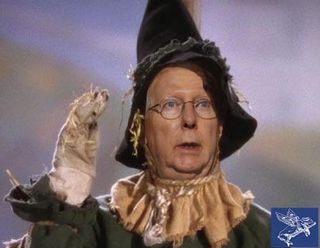
Ron Beasley at Newshoggers has the appropriate image of Senator Mitch McConnell in his post yesterday entitled, “If He Only Had a Brain” :
McConnell continues to mindlessly repeat Frank Luntz talking points about “endless taxpayer bailouts of Wall Street banks,” talking points written before there was an actual bill. Rachel Maddow compares the similarity, purely coincidental I’m sure, between Luntz’s “words to use” and McConnell’s statements:
“These are very serious charges against a key supporter of President Obama’s bill to create a permanent Wall Street bailout fund,” Boehner said Friday in the statement. “Despite President Obama’s rhetoric, his permanent bailout bill gives Goldman Sachs and other big Wall Street banks a permanent, taxpayer-funded safety net by designating them ‘too big to fail.’ Just whose side is President Obama on?”
“To hear the dim-witted Minority Leader put it, the Obama administration and Goldman Sachs are close allies, and the administration-backed reform bill is intended to help firms like Goldman Sachs. And we now know for sure that administration officials are carrying water for Goldman Sachs because … they just charged Goldman Sachs with fraud.
What?
I’m trying to imagine the conversation in Boehner’s office when the statement was being written. Which genius on Boehner’s staff discovered that the Obama administration is going after Goldman Sachs, regardless of its campaign contributions to Obama, and thought, “A ha! Now we’ve got ’em!“
I would guess that genius was the Orangeman himself.
“We are united in our opposition to the partisan legislation reported by the Senate Banking Committee. As currently constructed, this bill allows for endless taxpayer bailouts of Wall Street and establishes new and unlimited regulatory powers that will stifle small businesses and community banks.”
All words straight out of a Frank Luntz memo, telling Republicans how to maintain the status quo while sounding like they are in favor of reform. In other words, just repeat the Luntz-inspired tactics from the health care debate, with “endless taxpayer bailouts” replacing “death panels” as the lie du jour. And a lie is exactly what it is. What will guarantee “endless taxpayer bailouts” is doing nothing. The proposed reform calls for applying the same process to the “too big to fail” institutions that the FDIC uses every day for dealing with banks that become insolvent.
Would this bill perpetuate bailouts? SHEILA BAIR: The status quo is bailouts. That’s what we have now. If you don’t do anything, you are going to keep having bailouts.
But does this bill stop them from happening? BAIR: It makes them impossible and it should. We worked really hard to squeeze bailout language out of this bill. The construct is you can’t bail out an individual institution – you just can’t do it.
If this had been law prior to 2008, would we have seen the bailouts that took place? BAIR: No. You could not do an AIG, Bear Stearns, or any of that…This bill would only allow system-wide liquidity support which could not be targeted at an individual firm. You can’t do capital investments at all, period. It’s only liquidity support. No more capital investments. That’s banned under all circumstances.
Do you see any way left for the government to bail out a financial institution? BAIR: No, and that’s the whole idea. It was too easy for institutions to come and ask for help. They aren’t going to do that. This gives us a response: “Fine, we will take all these essential services and put them in a bridge bank. We will keep them running while your shareholders and debtors take all your losses. And oh, by the way, we are getting rid of your board and you, too.”
Here’s all you need to know about the dishonesty of Senate Republicans. One provision of the bill is for a $50 billion fund to dismantle the “too big to fail” banks. The fund is made up entirely of money which comes from the big banks, not one thin dime from the taxpayers. Republicans want this provision removed. But even if it goes, will they support the remainder of the legislation? I think you can guess the answer:
“McConnell suggested it wouldn’t be enough to satisfy Republicans.
“I appreciate the Obama administrations recognition of the need to substantively improve this bill,” McConnell said. “And I hope we can work with them to close the remaining bailout loopholes that put American taxpayers on the hook for financial institutions that become too big to fail.”
Oh by the way, how did the $50 billion get into the legislation to begin with? It was the result of negotiations between Banking Committee members Mark Warner (D-VA) and Bob Corker (R-TN). Needless to say, Corker now opposes the fund he negotiated to include.
The recent revelations about the goings-on at Washington Mutual bring back an old question about our friends the banksters. When is somebody going to jail? How about just charged and indicted? Something.
“Officials at the failed banking operations of Washington Mutual Inc. securitized substantial volumes of risky, fraudulent loans in the run-up to the financial meltdown despite repeated internal warning signs, according to a Senate probe.
The subcommittee has obtained documents showing that “at a critical point Washington Mutual included loans in its securities because they were likely to suffer a high rate of default, and they failed to disclose that to the buyers,” Sen. Levin said. “They also allowed loans that had been identified as fraudulent to be sold to buyers, again without alerting buyers when the fraud was discovered.”
Isn’t fraud a crime? Why are these executives testifying before Congress and not in a court of law? But then again, where else but the Wall Street bizarro world is this possible ?:
“March 26 (Bloomberg) — JPMorgan Chase & Co., Lehman Brothers Holdings Inc. and UBS AG were among more than a dozen Wall Street firms involved in a conspiracy to pay below-market interest rates to U.S. state and local governments on investments, according to documents filed in a U.S. Justice Department criminal antitrust case.
A government list of previously unidentified “co- conspirators” contains more than two dozen bankers at firms also including Bank of America Corp., Bear Stearns Cos., Societe Generale, two of General Electric Co.’s financial businesses and Salomon Smith Barney, the former unit of Citigroup Inc., according to documents filed in U.S. District Court in Manhattan on March 24.
…None of the firms or individuals named on the list has been charged with wrongdoing.”
“In the years before its collapse, Lehman used a small company — its “alter ego,” in the words of a former Lehman trader — to shift investments off its books.
The firm, called Hudson Castle, played a crucial, behind-the-scenes role at Lehman, according to an internal Lehman document and interviews with former employees. The relationship raises new questions about the extent to which Lehman obscured its financial condition before it plunged into bankruptcy.”
Isn’t that pretty much what Lay, Skilling, and Fastow were doing at Enron? So why no perp walks yet for the former execs at Lehman?
In the JPMorgan–Jefferson County scam, the crooked politicians went to jail, the banksters took the money and ran. Somebody say double standard?
“The only deterrent available is to start throwing the scammers in prison. All of them. We can start with the people at WaMu and Lehman, then go down the list and for each and every firm that cooked its balance sheet, nailing them under SarBox [Sarbanes-Oxley] as well. While we’re at it jail every bank executive involved in crooked derivatives deals with municipal and state governments, starting with Jefferson County in Alabama.”
In what has become SOP for this administration, President Obama has once again capitulated under the slightest pushback from the GOP obstructionists, although without too much of a struggle I might add. After leaving his nominee to head the OLC, Dawn Johnsen to “twist in the wind for more than a year,” Ms. Johnsen withdrew her nomination.
“The struggle between President Obama and Republicans on Capitol Hill has claimed a fresh victim — Dawn Johnsen. She was Mr. Obama’s choice to lead the Office of Legal Counsel at the Justice Department. Ms. Johnsen withdrew her nomination after more than a year. It was clear that the White House was not going to fight to save her from Republicans who were refusing to allow a vote on her confirmation.
Ms. Johnsen’s problem was not that she lacked strong qualifications to be the legal adviser to the executive branch, informing the White House about what the law requires and what it prohibits.”
Ms. Johnsen’s “problem” was that she is a staunch advocate for the limitation of executive power and an opponent of the president’s “look forward, not back” policy in relation to dealing with abuses of power by the previous administration. In a March, 2008 piece in Slate she wrote:
“The question how we restore our nation’s honor takes on new urgency and promise as we approach the end of this administration. We must resist Bush administration efforts to hide evidence of its wrongdoing through demands for retroactive immunity, assertions of state privilege, and implausible claims that openness will empower terrorists.”
[…]
“Here is a partial answer to my own question of how should we behave, directed especially to the next president and members of his or her administration but also to all of use who will be relieved by the change: We must avoid any temptation simply to move on. We must instead be honest with ourselves and the world as we condemn our nation’s past transgressions and reject Bush’s corruption of our American ideals. Our constitutional democracy cannot survive with a government shrouded in secrecy, nor can our nation’s honor be restored without full disclosure.”
“What Johnsen insists must not be done reads like a manual of what Barack Obama ended up doing and continues to do — from supporting retroactive immunity to terminate FISA litigations to endless assertions of “state secrecy” in order to block courts from adjudicating Bush crimes to suppressing torture photos on the ground that “opennees will empower terrorists” to the overarching Obama dictate that we “simply move on.”
Could she have described any more perfectly what Obama would end up doing when she wrote, in March, 2008, what the next President “must not do”?
A rhetorical question, I presume. The answer is painfully obvious.
“It was like a hidden passage on Wall Street, a secret channel that enabled billions of dollars to flow through Lehman Brothers.
In the years before its collapse, Lehman used a small company — its “alter ego,” in the words of a former Lehman trader — to shift investments off its books.
“Entities like Hudson Castle are part of a vast financial system that operates in the shadows of Wall Street, largely beyond the reach of banking regulators. These entities enable banks to exchange investments for cash to finance their operations and, at times, make their finances look stronger than they are.”
The firm, called Hudson Castle, played a crucial, behind-the-scenes role at Lehman, according to an internal Lehman document and interviews with former employees. The relationship raises new questions about the extent to which Lehman obscured its financial condition before it plunged into bankruptcy.
[…]
And sadly, it’s still going on:
“Even now, a year and a half after Lehman’s collapse, major banks still undertake such transactions with businesses whose names, like Hudson Castle’s, are rarely mentioned outside of footnotes in financial statements, if at all.”
Who says crime doesn’t pay? If you happen to be a bankster or the crook who caused the collapse at AIG which, but for $182 billion courtesy of that never-ending ATM known as the American taxpayer, nearly led to the meltdown of our entire financial system, it pays like a Las Vegas slot machine. Consider the cases of Charles Prince, former Citigroup CEO, and Joseph Cassano, former head of AIG’s Financial Products Unit.
“I’m sorry that the financial crisis has had such a devastating impact on our country. I’m sorry for the millions of people, average Americans, who have lost their homes. And I’m sorry that our management team, starting with me, like so many others, could not see the unprecedented market collapse that lay before us.”
“Prince, arguably the person most responsible for Citigroup’s enormous problems, can expect at least a $12.5 million cash bonus, compared with last year’s cash payout of $13.8 million.
And as he awaits his official retirement next month, Prince can rest assured that he will leave with $68 million, including his salary and accumulated stockholdings; a $1.7 million pension; an office, car and driver for up to five years — all in addition to the bonus. That is on top of $53.1 million he has taken home in the last four years, a period when $64 billion in the company’s market value has evaporated.”
However, Mr. Prince is a pauper compared to the HCIC (head crook in charge) at AIG, Joseph Cassano:
“Joseph Cassano was the head of AIG’s Financial Products Unit. They are the ones that made about a trillion dollars worth of bets in credit default swaps. They lost.
So, what happened to Cassano? This was all his idea and his team that brought on this colossal collapse. Well, he was fired! Great, justice served…Oh, did I forget to mention one thing? He received $35 million in bonuses when he was let go.”
…When they lost the bets, their company was devastated. Completely and utterly bankrput. The failure was so large, it promised to drag down the rest of the global economy with it. This forced the government to step in and cover their losses. So far, the United States taxpayers have put in $182 billion to keep AIG afloat.
That 35 mil was only tip money for Cassano:
“How much did he make for himself from 2000 to 2008 by gambling with the company’s money? Only $280 million…In the end, he walked away with over $315 million for destroying the company and maybe the whole economy.”
All that and no accountability required:
“This week the Wall Street Journal reported that prosecutors will likely not charge him with fraud. They are not going to try for clawbacks to get some of the money back. In the end, he gets away scott-free. But it’s better than free, he gets to keep all the money he never really made in the first place…”



 Desperado's Outpost